THE A321: ADDING CAPACITY CHANGED THE AIRCRAFT
The A321 became the longer single-aisle family member. Lufthansa records receiving its first aircraft on 27 January 1994. More cabin capacity was the commercial purpose, but the operational result included a longer fuselage, different geometry and variant-specific systems. A familiar cockpit helped the fleet remain coherent while the airframe still needed its own performance and handling briefing. [188, 27 January 1994 entry]
The 1998 manufacturer briefing presents the A321 separately in its dimensions, masses and systems. Its length is 44.51 metres, compared with 37.57 metres for the A320. Turning clearance, visual judgement and ground-contact geometry must consequently be evaluated for the actual aircraft. A cockpit resemblance is not evidence that every fuel control or takeoff technique is interchangeable. [166, PDF p. 7]
The Pro systems and performance sections follow that distinction through fuel transfer, additional tanks, high-lift configuration and operational margins. They separate certified model identity from the choices actually offered by Fenix. The historical family relationship explains the shared starting point; the variant register explains the differences that matter for a particular flight. [49, SOP applicability and configuration discipline]
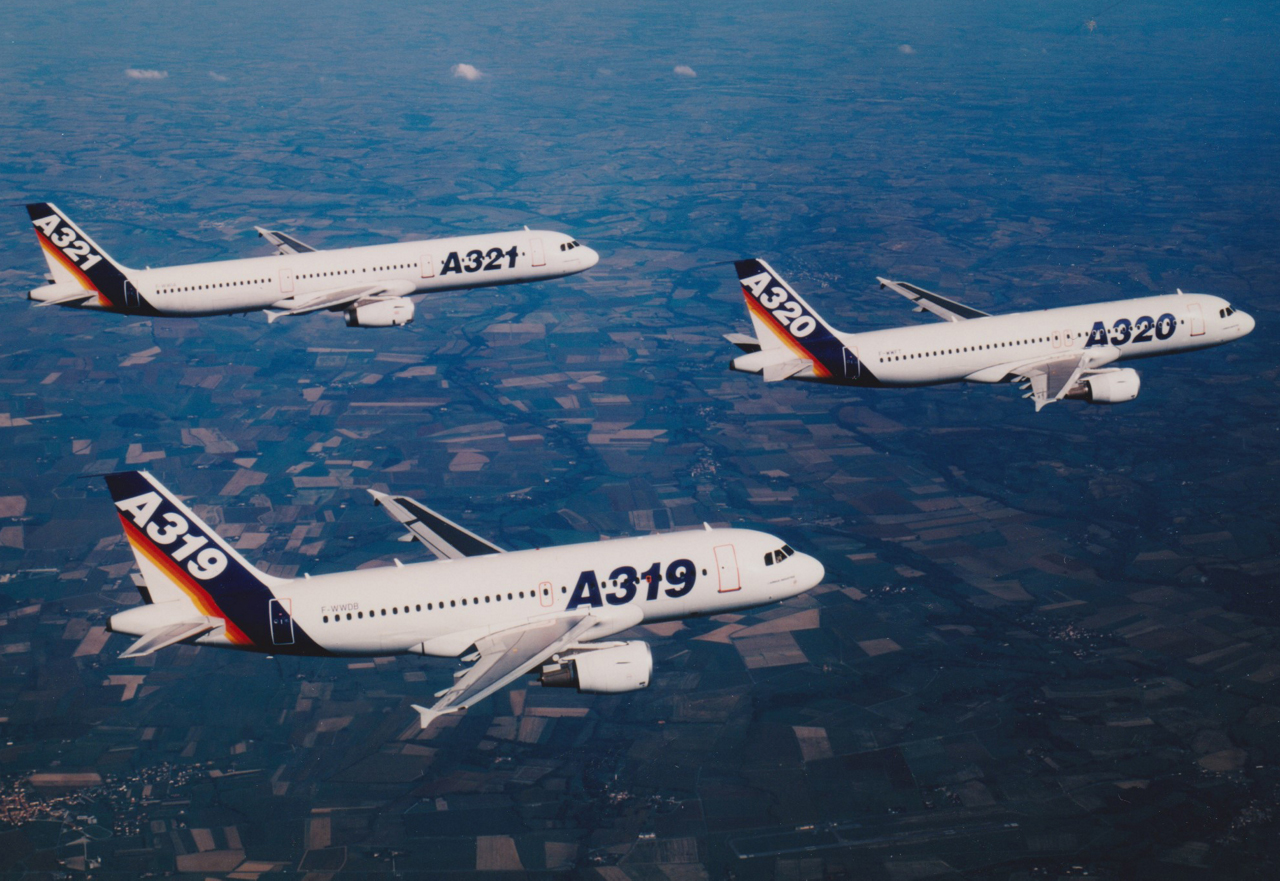
The original-engine A320 family in Airbus’s archive: A321 at upper left, A320 at upper right and A319 in the foreground. © Airbus; original manufacturer image. No individual photographer credit is visible. [189]