AIR-DATA AND INERTIAL REFERENCES AS INDEPENDENT FUNCTIONS
An ADIRU contains an air-data reference part and an inertial-reference part. The supplied description identifies three units and permits the two functions to fail separately. ADR outputs include airspeed, Mach, pressure-derived altitude, angle of attack and temperature. IR outputs include attitude, heading, track, rates, acceleration, groundspeed and position. Their consumers extend beyond PFD and ND to guidance, engine/control computers, warning functions and pressure control. A sensor disagreement can therefore generate a family of downstream consequences without every consuming computer having failed. [65, PDF pp. 3–5]
Pitot, static, angle-of-attack and temperature probes measure different physical quantities. Pressure-derived airspeed and altitude do not become valid merely because GPS position or groundspeed appears plausible. Equally, an inertial-reference fault does not prove all air-data output from the same box is lost. Identify which function is unavailable, which source feeds each crew display and which comparisons remain independent. This preserves useful information and avoids turning a three-source installation into a single source through an unexamined switching action. [65, PDF pp. 3–5] [21, Unreliable-speed/flight-instrument principles, source effectivity applies]
NAV alignment requires the intended position and a stationary aircraft. On the illustrated keypad-equipped overhead the selector order is IR1, IR3, IR2 from left to right. Read unit numbers, not an assumed sequence. ALIGN, FAULT and ON BAT indications have distinct meanings, including transient indications within normal initialization. ATT is a degraded attitude/heading function described in the source; it is not a shortcut to normal navigation alignment. Exact heading-entry and renewal requirements belong to the installed unit and applicable procedure. [65, PDF pp. 6–8] [66, PDF pp. 102–112]
A reference reset can remove information as well as clear a symptom. Before a failure exercise, identify the initial source configuration, affected ADR or IR function and downstream mode/law effects. The current Fenix configuration register distinguishes alternative overhead standards on the named platform. A historical keypad drawing should not be used to invent a confirmation button on another panel. Use the illustration for architecture and exact unit arrangement, and match every operational selection to the actual installed interface and procedure. [65, PDF pp. 6–8] [70, Available Options: fnx_adirs_type; platform effectivity]
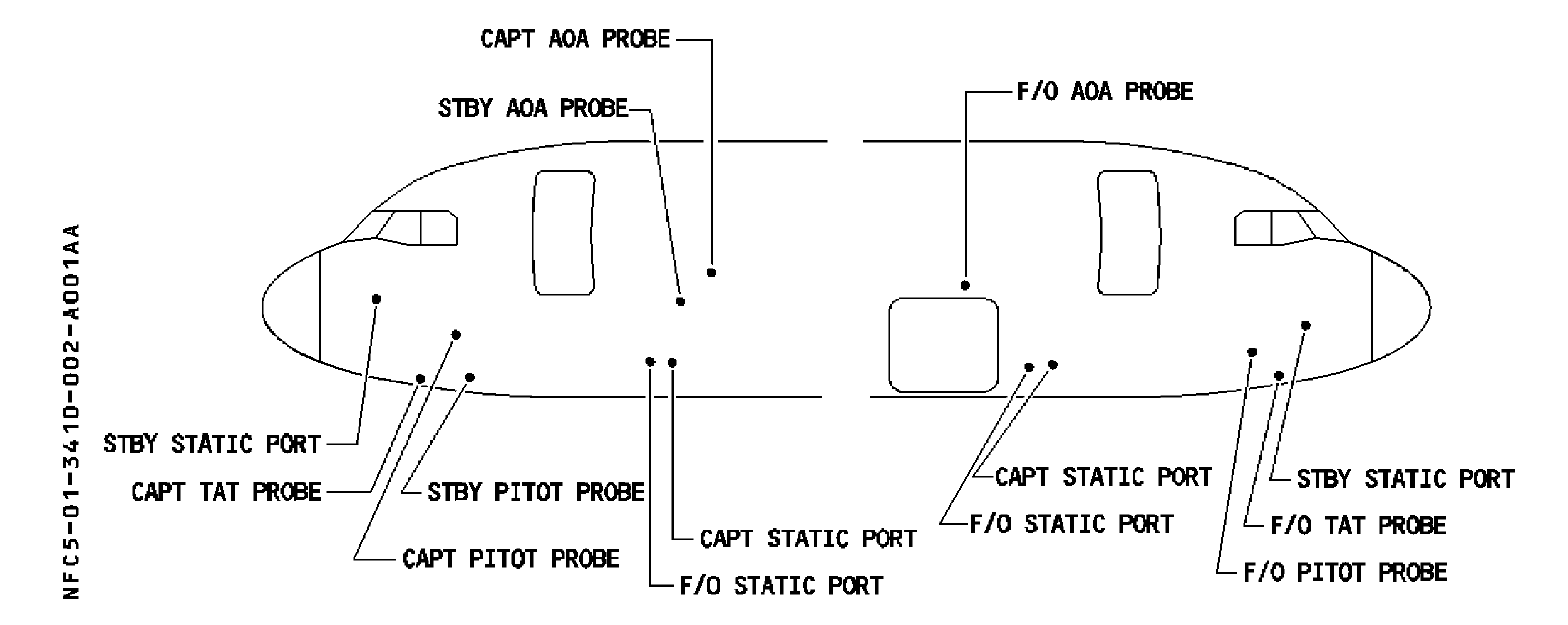
A320 air-data probe locations on the actual nose profile. [65, PDF p. 4]