DIFRIPPS: A STRUCTURED PREPARATION AND REVIEW
DIFRIPPS provides a page sequence: Data, Init A, Flight Plan, Rad Nav, Init B, Progress, Performance and Secondary Flight Plan. Its practical value is completeness. Follow the same review after an imported route, a manual entry or a significant change, while recognising which data are ready to finalise. [100, Unpaginated, single paragraph]
Separate navigation preparation from the later mass and takeoff-performance work. Final loading data can arrive after the route is complete. Leave the affected preparation open until those inputs are confirmed, then return through the relevant checks rather than accepting earlier provisional figures by habit. [59, PDF pp. 6-8]
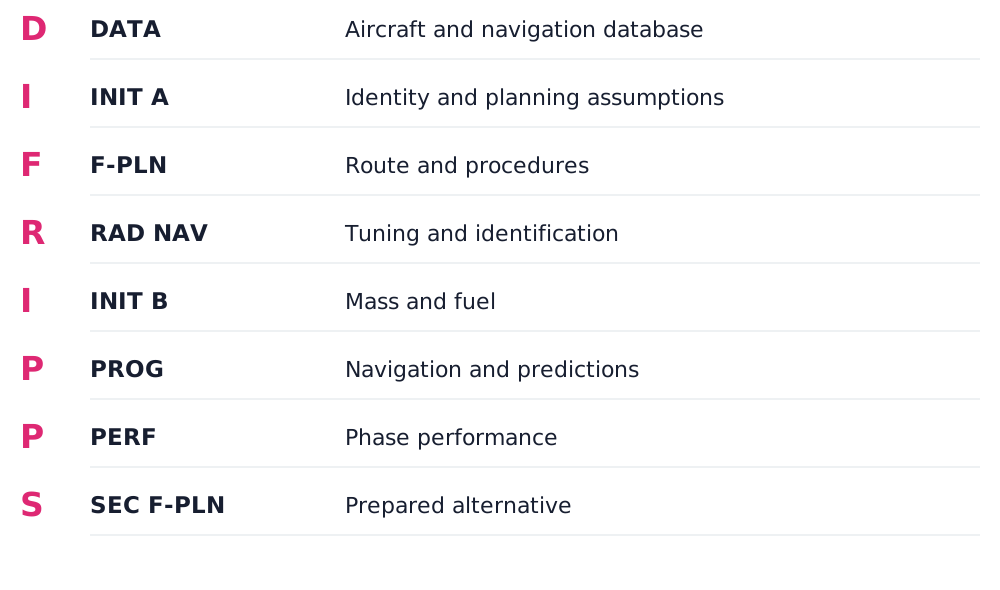
The supplied DIFRIPPS sequence, expanded into the actual page names and review task. [100, Unpaginated, single paragraph]
IN PRACTICE: Use DIFRIPPS as two working passes
Before you begin: The MCDU is available and the flight identity is known. Loading may still be in progress; final performance work must wait for its actual inputs.
1. Confirm the order you will use
Action. Follow Data, Init A, Flight Plan, Rad Nav, Init B, Progress, Performance and Secondary Flight Plan. Use this as a personal review route through the pages, not as permission to skip the aircraft checklist.
Check. You have a repeatable order and can return to a specific incomplete item after an interruption. [100, Unpaginated, single paragraph] [101, Spoken explanation of DIFRIPPS and MCDU preparation]
2. Finish the navigation inputs first
Action. Settle the active navigation database, flight identity and intended route. Review radio-navigation selections that belong to the departure or anticipated arrival. Mark any item still awaiting a clearance.
Check. The route has a clear origin, destination and reason for each selected procedure. An assumption is visibly separate from a clearance. [59, PDF pp. 6-8] [66, PDF pp. 99-128]
3. Keep final loading work together
Action. When loading is final, revisit INIT B and compare the accepted mass and fuel entries with the aircraft and latest loadsheet. Then review PROG and complete the takeoff-performance work.
Check. The performance calculation uses the same aircraft, load and runway assumptions as the final preparation. [66, PDF p. 123] [66, PDF pp. 125-128]
4. Build the spare from a checked route
Action. Prepare the secondary plan after the active plan has been reviewed. Decide what the spare is for: a genuine runway-change option or a separately prepared return, rather than a second unexamined copy.
Check. The secondary plan has a specific purpose and does not conceal an unresolved error in the active plan. [66, PDF p. 121] [66, PDF pp. 432-435]
5. Close the loop on a change
Action. After a runway, loading or route change, return to the pages it affects. Recheck the route, weights, takeoff calculation and secondary plan as applicable; do not simply resume at the next letter.
Check. The preparation is internally consistent again, including entries made earlier in the session. [66, PDF pp. 142-165] [66, PDF p. 128]
Complete when: Each page has a defined job. Navigation preparation is coherent, while weight-dependent entries remain open until the final information is available.