TMPY: AN EXPLICIT TRANSACTION WITH INSERT AND ERASE
TMPY is a proposed revision while the current active plan continues to provide its existing guidance. In the cited standard, the proposed path and page state use yellow presentation, with explicit INSERT and ERASE prompts. Use that separation to inspect the complete change. A yellow leg that looks correct is still a proposal until insertion; ERASE cancels that proposal rather than undoing an already accepted active edit. [66, PDF pp. 312-315,342,642-644]
1. Establish a clean edit boundary. Before starting a new task, determine whether a temporary plan already exists and why. Inspect it or erase it deliberately. An unfinished change can block operations such as a new initialization or a DIR TO and can combine with a later edit in ways the operator did not intend. Do not commit an unknown earlier proposal merely to unlock the next page. [66, PDF pp. 312-315,342,642-644]
2. Build the intended transaction. Make the required route or vertical revision, then identify TMPY and inspect its scope. Changing an arrival can re-string multiple segments, and deleting a fix can remove its constraints. Review neighbouring legs and resulting distances rather than only the field that was typed. Note that special operations, especially DIR TO, can restrict additional revisions while their proposal is pending. [66, PDF pp. 312-315,342,642-644]
3. Resolve a competing DIR TO state. If DIR TO IN PROCESS or an insert/erase-related message appears, finish or cancel that specific transaction before resuming unrelated programming. A message is describing state, not asking for an arbitrary new number. Read the selected direct target and ND preview again before committing, particularly if the aircraft has moved significantly during the interruption. [66, PDF pp. 312-315,342,642-644]
4. Insert deliberately. Read the actual INSERT prompt, commit and inspect the resulting active sequence and mode state. A divergent path may require an appropriate heading/track state before activation in the documented standard. If SELECT HDG/TRK FIRST appears, understand the guidance consequence rather than treating it as a keypress puzzle. Coordinate the intended guidance with the cleared route before further commitment. [66, PDF pp. 312-315,342,642-644]
5. Check cancellation versus recovery. Before insertion, ERASE provides a straightforward return to the existing plan. After insertion, repair uses a new understood revision or a deliberately prepared alternative; there is no general guarantee of an unlimited undo stack. Retain the OFP/clearance reference so that recovery restores the intended route, not merely a plausible-looking replacement. [66, PDF pp. 312-315,342,642-644]
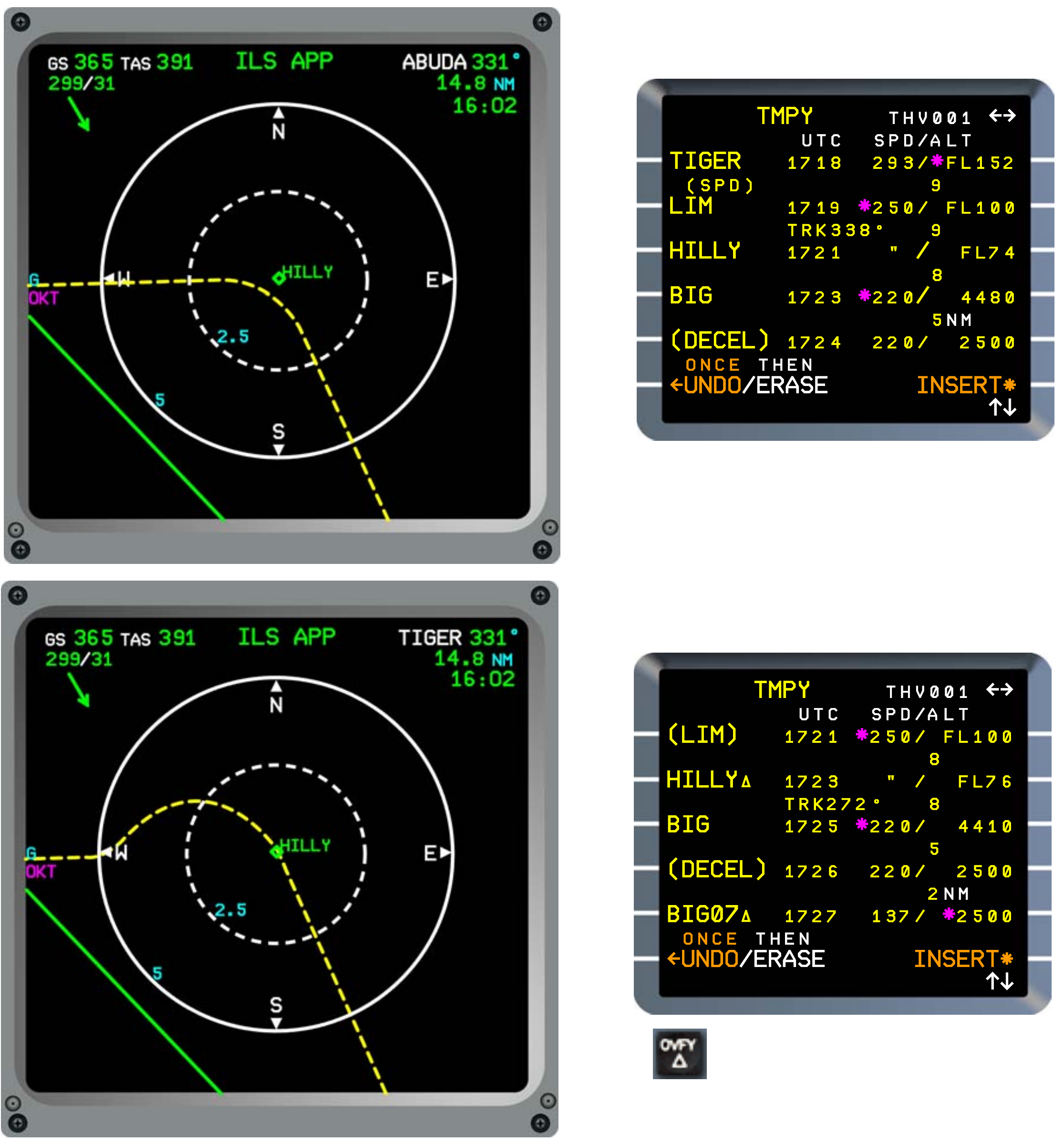
Manufacturer reference: complete ND and temporary-plan panels comparing the source bypass and overfly revisions at HILLY. Identified Thales FMS2 REV1 standard; historical identifiers and predictions. [66, PDF p. 312]