FLIGHT-PHASE TRANSITIONS: APPROACH ACTIVATION, GO-AROUND AND RETURN
Flight phases drive speed scheduling, predictions and data availability. Opening PERF APPR for preparation is different from ACTIVATE APPR PHASE and its confirmation, which actually changes the phase. The guide's automatic triggers and option thresholds belong to the identified standard. Read the active page/title and actual FMA rather than assuming that crossing a remembered distance or seeing the next page proves the phase has changed. [66, PDF pp. 175-176,185-196,248-249,274-284,287-291]
1. Establish the actual phase. Inspect the current PERF/PROG context and relevant guidance. A cruise level-off, a descent clearance and approach preparation can exist at different stages of the logic. NEXT/PREV PHASE lets the crew browse future information. Use that capability to prepare without prematurely changing the active phase, particularly while reviewing landing data well before descent. [66, PDF pp. 175-176,185-196,248-249,274-284,287-291]
2. Activate approach deliberately when required. Where the actual workflow calls for manual activation, select ACTIVATE APPR PHASE and read CONFIRM APPR PHASE before committing. Check the resulting phase and speed target. A temporary heading/vectoring situation can change automatic activation expectations. Do not assume that this command is equivalent to pressing FCU APPR or that it arms radio final guidance. [66, PDF pp. 175-176,185-196,248-249,274-284,287-291]
3. Inspect go-around route changes. With a genuine go-around, read the missed approach becoming the working route and the corresponding PERF GO AROUND page. Check THR RED/ACC/engine-out acceleration references and the current FMA. The source's retained approach after a discontinuity is preparation for a possible subsequent approach, not a clearance to turn back immediately or a guarantee that all earlier constraints still apply. [66, PDF pp. 175-176,185-196,248-249,274-284,287-291]
4. Prepare another approach from the current position. Confirm the intended runway/procedure and route sequencing, then use the appropriate phase reactivation where required. Inspect stored weather, minima, configuration and mass-dependent information again. A repeat approach is a new operational case even when much of the stored data remains suitable. NAV-in-go-around equipment options also change expectations and must match the loaded configuration. [66, PDF pp. 175-176,185-196,248-249,274-284,287-291]
5. Investigate an unintended phase change. Establish which phase, active route and guidance state actually exist, then use the current documented function for the intended next operation. This guide supplies no legacy cruise-reference reset trick as a V3 recovery procedure. Do not cycle databases or alter clearance levels merely to recover a preferred page title. Verify both the resulting preparation state and actual guidance after any supported correction. [66, PDF pp. 175-176,185-196,248-249,274-284,287-291]
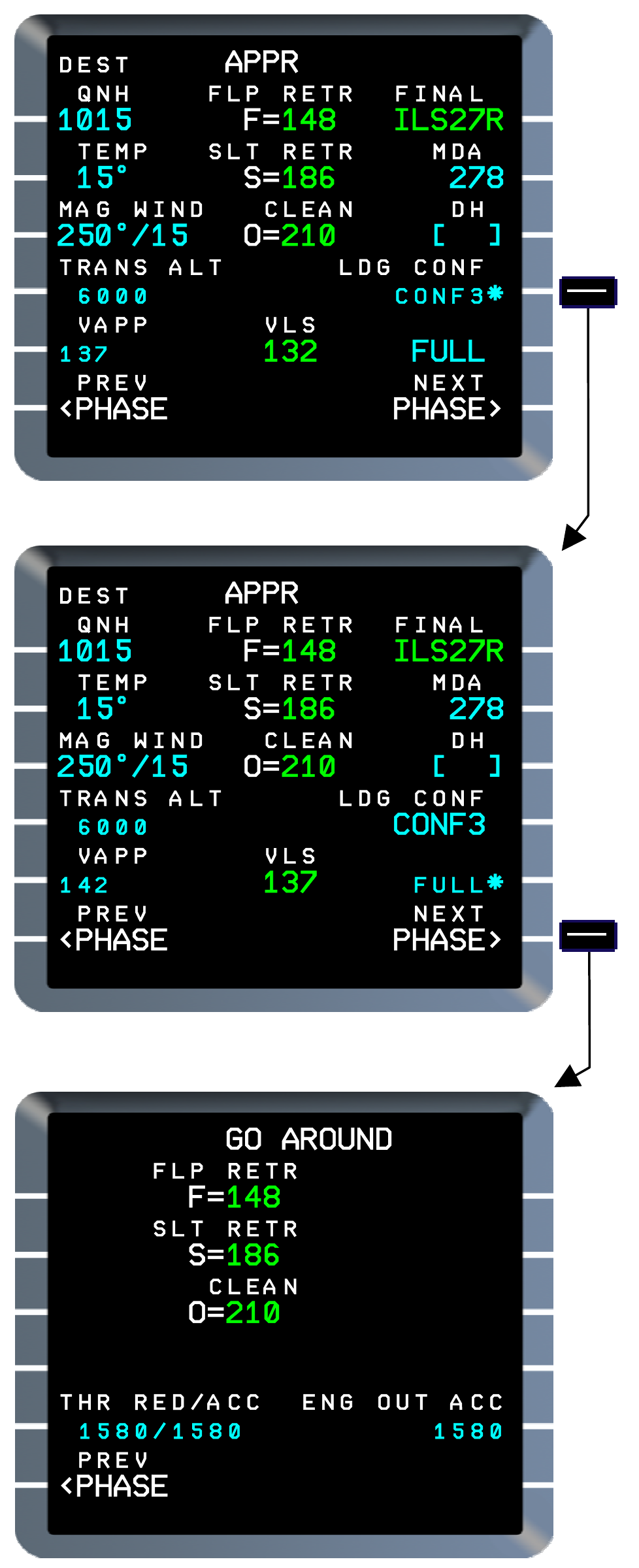
Manufacturer reference: approach-minimum/configuration options and go-around preparation in Thales FMS2 REV1. Displayed minimum values, altitudes and page options are source examples; use current charts, equipment and V3 fields. [66, PDF p. 207]
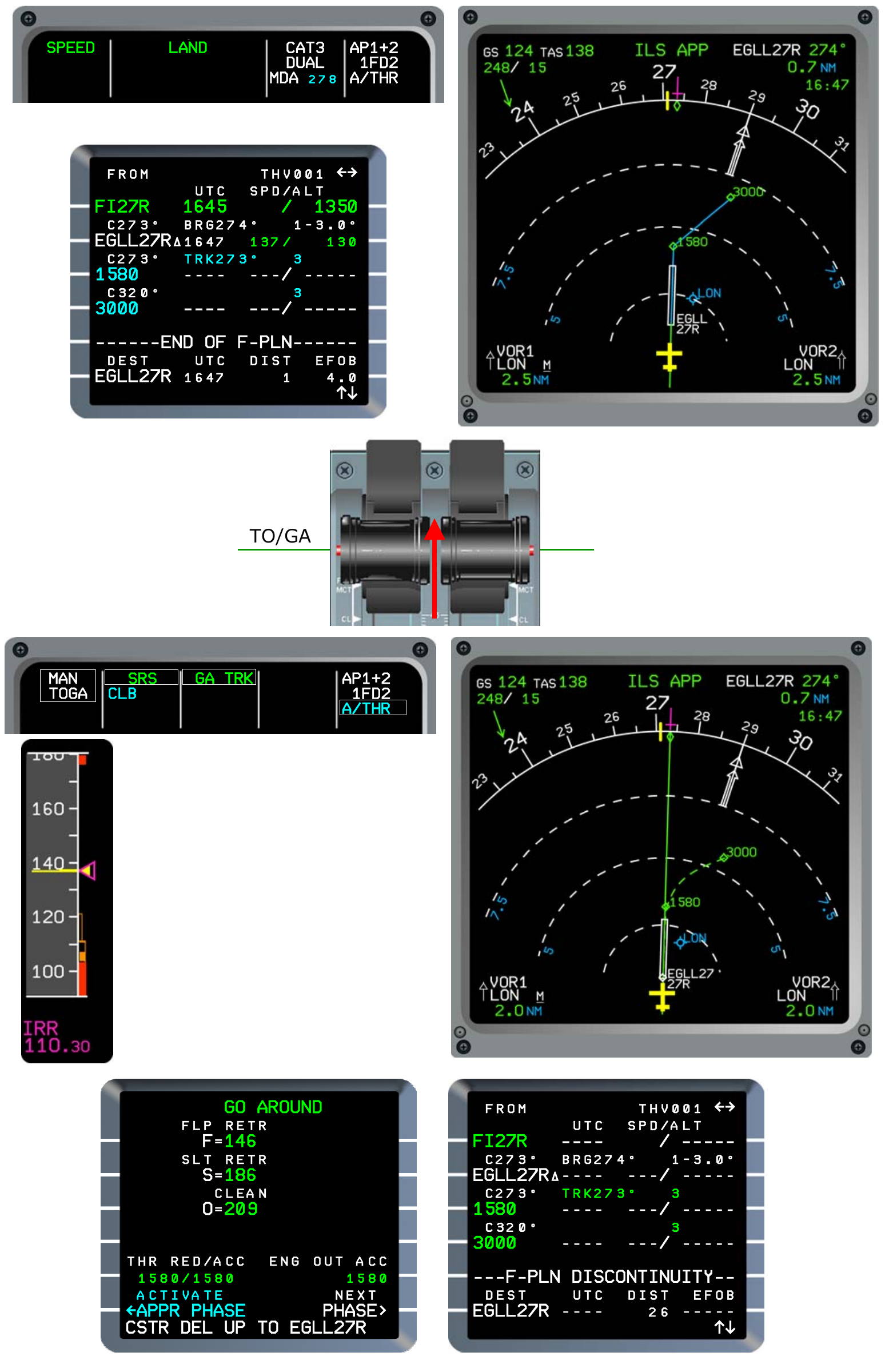
Manufacturer reference: the source standard's GA TRK go-around example and missed-approach route activation. Fenix V3 has a configurable NAV-in-go-around option; this is not a universal current FMA sequence or instruction to fly the source procedure. [66, PDF p. 275]