HOLD EXIT, RESUME AND A SEQUENCING DISCREPANCY
In the source standard, IMM EXIT behaves differently before entry and while established in the hold. Before entry it removes the hold and resumes the flight-plan continuation without the same racetrack manoeuvre. In the hold it constructs an exit via the holding fix and offers a resume function. Fenix's V3 improvements and dated HM issue make readback of the actual resulting geometry particularly important. [66, PDF pp. 365-372] [83] [82]
1. Establish the current holding state. Identify whether the aircraft is approaching the hold, flying its entry, established in the racetrack or already following an exit. Read the active fix/leg and FMA. A stored pattern in SEC or an uninserted TMPY is not the same as an active holding command. The correct exit action depends on which state actually exists. [66, PDF pp. 365-372] [83]
2. Confirm the cleared continuation. Before selecting IMM EXIT, inspect the route after the holding fix and resolve the intended connection. A hold exit cannot supply a missing onward clearance. Check the next altitude/speed requirement and current FCU targets so that leaving the racetrack does not immediately expose an unprepared vertical or lateral transition. [66, PDF pp. 365-372] [83]
3. Select exit and inspect the proposed result. Read the changed prompt and ND path. While established, the documented system aims to leave through the holding fix rather than abandon the pattern in an arbitrary direction. Confirm that the aircraft is following the expected exit and that the correct subsequent leg sequences. Message clearance or prompt disappearance alone is not proof of correct exit tracking. [66, PDF pp. 365-372] [83]
4. Use resume only for the intended return to holding. The source's RESUME HOLD function reactivates the pattern while the exit state permits it. Read the resulting racetrack, active leg and guidance again. Do not alternate exit/resume rapidly as a generic repair. Each command changes the flight path and must remain consistent with clearance and the actual position in the pattern. [66, PDF pp. 365-372] [83]
5. Handle a software discrepancy as evidence, not a guessed workaround. Dave's 24-25 October 2026 report identifies HM sequencing under investigation. If the simulated continuation is wrong, preserve an understood cleared guidance state and inspect the active route before any repair. Record the exact entry, hold type, exit command and observed leg. No universal DIR TO, deletion or re-entry workaround is established by that dated report. [66, PDF pp. 365-372] [83]
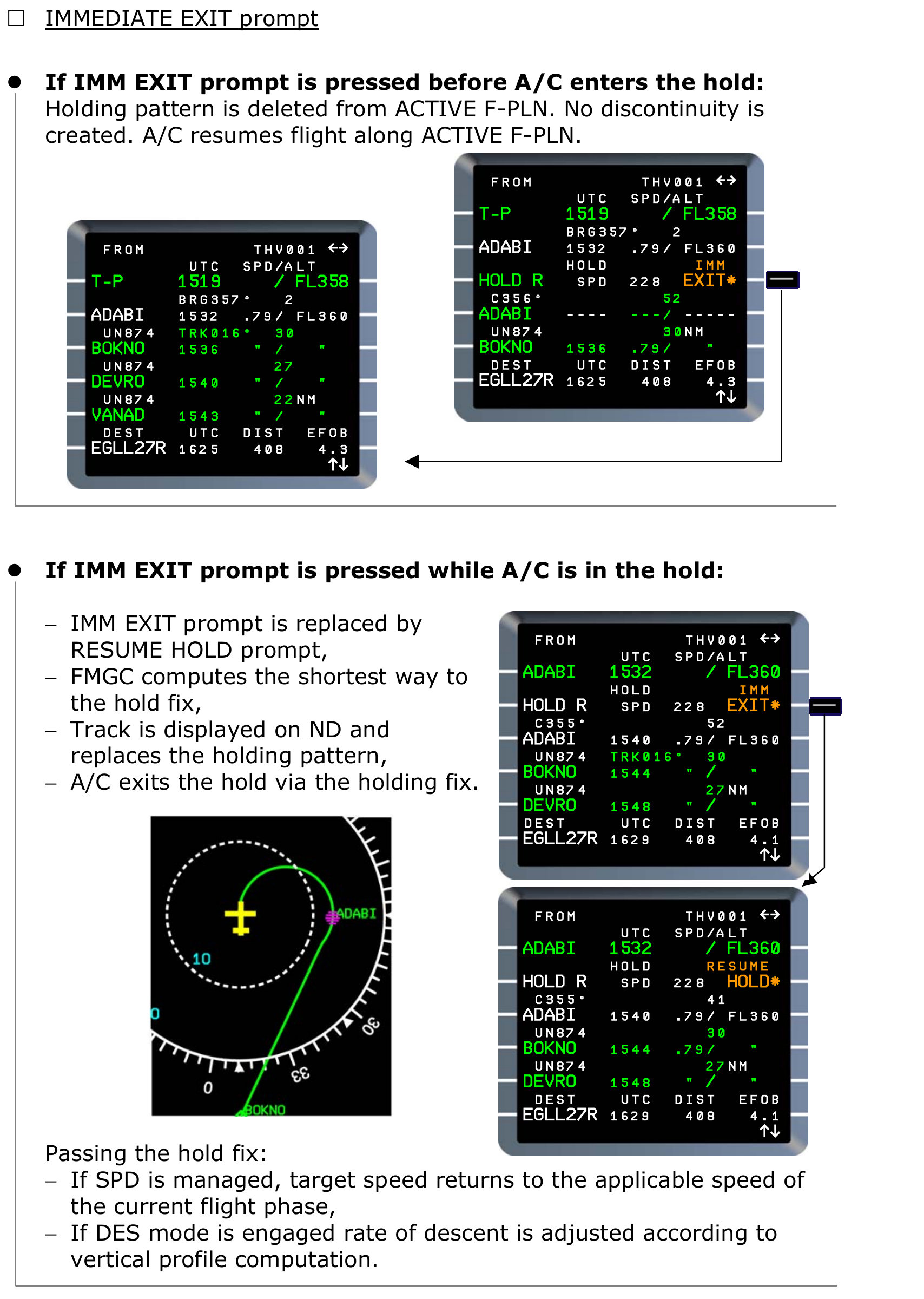
Manufacturer reference: different hold-exit states in the identified Thales standard. Not a claimed V3 workaround. Compare with the actual current build and the dated manual-hold sequencing qualification in the text. [66, PDF p. 370]