CHOOSE MODES BY THE TASK THEY CONTROL
Keep speed, vertical guidance, lateral guidance and thrust as separate parts of the control problem. A selected heading can coexist with a managed speed; an open climb can coexist with NAV. The real FMA photograph in the baseline guide shows THR CLB, OP CLB and NAV, with ALT armed. That combination is internally coherent. OP CLB identifies the vertical strategy, not the status of every automatic function. Read each column and connect it to the corresponding target before deciding that the whole aircraft is in a single managed or selected state. [21, PDF pp. 51–64]
Managed guidance uses the flight-management plan within the authority given through the FCU and the active modes. Selected guidance uses the applicable immediate target. A pull or push is a request whose result depends on the control, flight phase and engagement conditions. Crosscheck the FMA rather than using the control movement as evidence that the request succeeded. Also distinguish an armed mode from an active one and a capture mode from settled tracking. In an intercept, the aircraft can remain in its present guidance while the desired approach mode is only waiting. [21, PDF pp. 51–64]
The selected altitude defines an important normal-climb/descent boundary, while flight-plan constraints and the chosen vertical mode determine how intermediate restrictions are treated. Managed CLB and DES are not equivalent to OP CLB and OP DES. Before making an open-mode request, identify which restrictions will require separate pilot attention. The clearance remains the external limit of authority; a coded restriction or an attractive computed profile does not issue a clearance. On approach, use the specific captured-guidance procedure for its relationship to subsequent FCU altitude changes. [114, PDF pp. 5–10] [116, PDF pp. 3–4,10–12] [108, PDF p. 5]
A useful intervention has an expected response. State the target, intended mode and next transition before selecting it, then compare pitch, thrust, turn and speed trends with that expectation. If the result differs, identify the actual active state before adding another command. Repeated selections made faster than their effects can be read tend to conceal the original problem. This matters during reversions as well as deliberate changes: a mode that has reverted may still be controlling the aircraft successfully while pursuing a different objective from the one the crew believes is active. [21, PDF pp. 51–64]
Practise the same climb or descent clearance with different compatible mode strategies, keeping the initial conditions fixed. Compare which restrictions are observed, how thrust and pitch control speed, and when altitude capture begins. Then change the lateral geometry and inspect the vertical prediction again. The exercise is complete when the pilot can explain why each strategy produced its particular path and identify the extra monitoring it required. Detailed FM programming belongs to the FM section; this topic concerns the operational decision to use the resulting guidance. [21, PDF pp. 125–128] [21, PDF pp. 141–146]
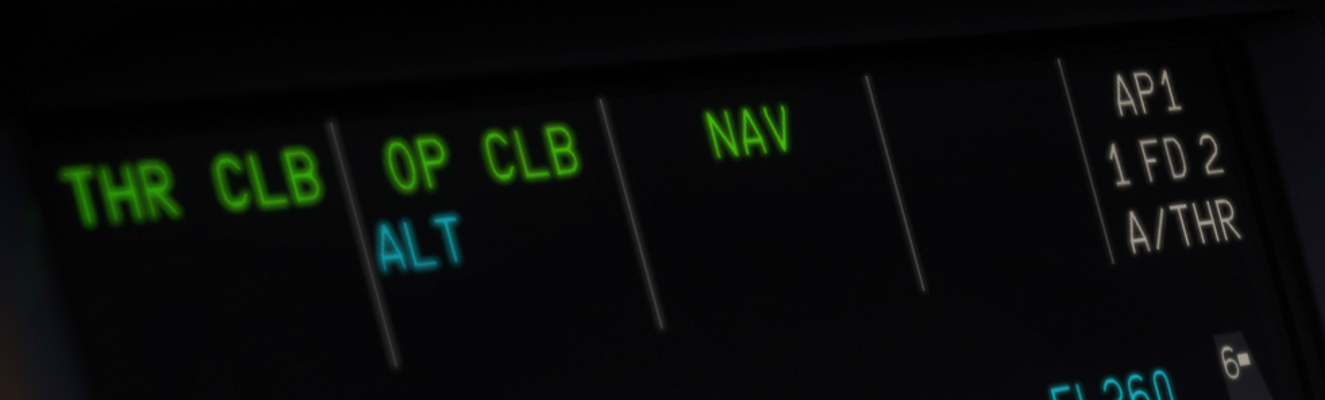
Detail of the actual Fenix FMA: THR CLB / OP CLB / NAV; ALT is armed. [1, Source illustration]