THE A300B: TWO ENGINES AND A WIDE BODY
The first A300B1 flew at Toulouse on 28 October 1972. Its defining combination was a wide-body cabin and two engines. Airbus needed a compelling operating proposition in an established market, and the A300 combined passenger capacity, cargo accommodation and efficiency into that proposition. The production aircraft would evolve beyond the first prototypes; an A300B1 photograph does not describe every later A300 model. [10, First flight and programme origins]
The project also changed before it flew. The British government withdrew in 1969, while Hawker Siddeley continued as an industrial participant supplying wings. Government participation, company workshare and consortium ownership were different things. The eventual aircraft reflected decisions about commercial risk and practical industrial capacity alongside its aerodynamic design. [10, Government withdrawal and industrial participation]
An engineering lineage describes reused structure, manufacturing knowledge and systems experience. It does not mean that the procedures of one type transfer unchanged to its descendants. This distinction becomes important when a supplied library contains several Airbus generations: familiar labels can conceal different system architectures and operating assumptions. [4, General and systems overview; historical comparison]
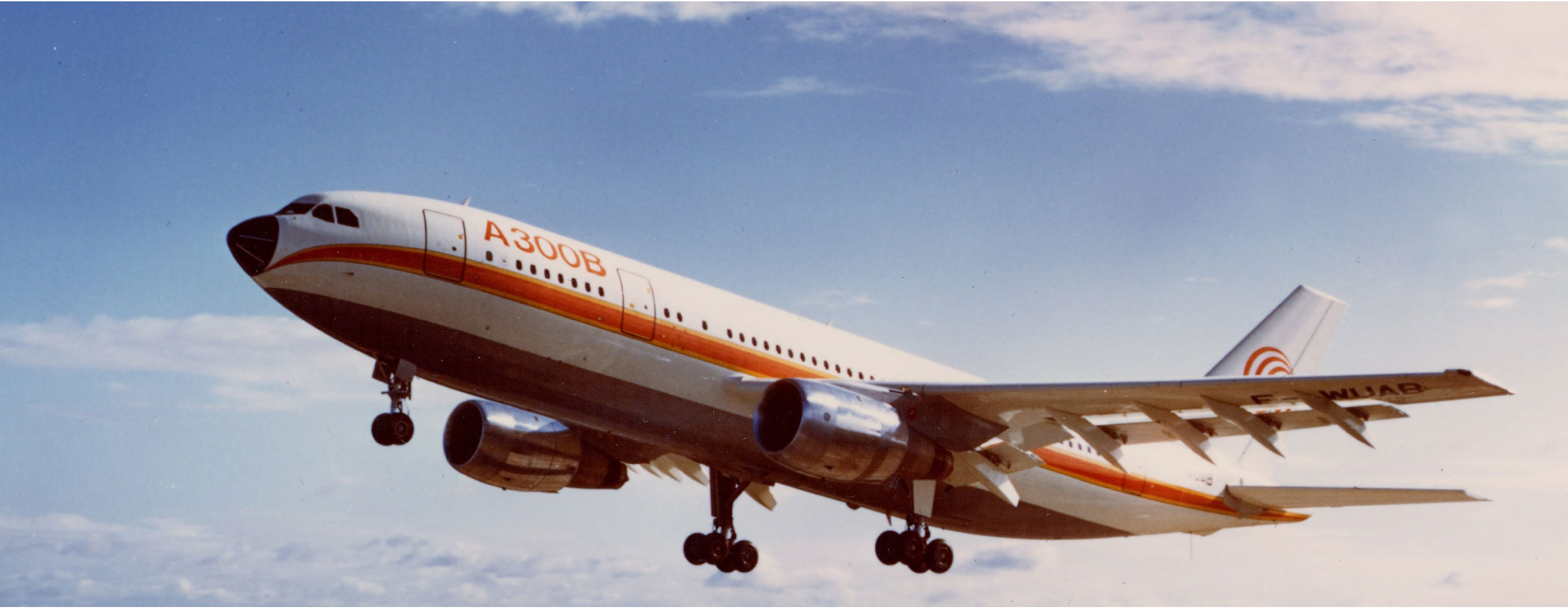
A300B photograph in the Airbus historical chronology. Original manufacturer image; the source places it beside the1972 first-flight milestone. [11, PDF p. 35]