EDDF-EGLL: THE EXERCISE DATASET
The worked sector uses an A320 with CFM engines and wingtip fences, EDDF-EGLL, flight identification MC2026 and EGKK as the teaching alternate. The example cost index is 20 and the intended cruise level FL280. These are stated exercise assumptions; the OFP and clearance for the flight you load establish the operational choices.
The mass-and-fuel example uses ZFW 60.0 tonnes, ZFWCG 27.0 percent MAC and block fuel 6.0 tonnes. Taxi fuel is 0.2 tonnes and trip fuel 2.4 tonnes. The resulting ramp, takeoff and landing masses are 66.0, 65.8 and 63.4 tonnes, leaving 3.4 tonnes at destination. The arithmetic is internally consistent; adequacy of the dispatch fuel plan depends on the actual planning assumptions and requirements.
The airway-entry exercise uses SOBRA Y180 BITBU Y181 DEMUL DCT DENUT L608 LOGAN from EUROCONTROL's May 2020 routing brief. This is a historical keyboard example. For a current sector, use a current route with compatible departure and arrival procedures. The distinction matters: an old recommended routing is useful practice material, but it does not establish today's route or clearance. [102, PDF p. 1]
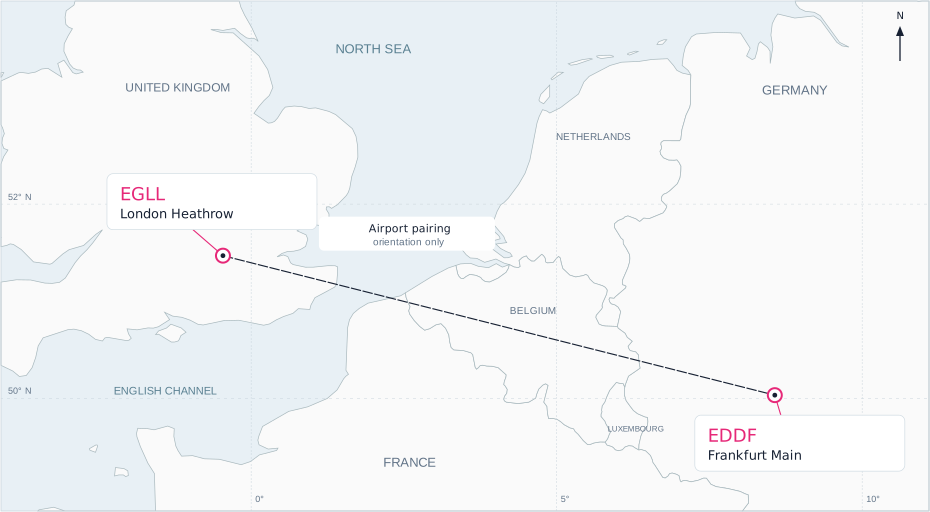
Frankfurt and London Heathrow in their geographic setting. The connector identifies the airport pair; it is not the filed route. [103, 1:50 million; version5.1.1] [104, AD2 EDDF1-1; AD2.2 item1] [105, EGLL AD2.2 item1]
IN PRACTICE: Set up the Frankfurt–Heathrow practice case
Before you begin: Use the stated fictional dataset for the exercise. For an actual simulator sector, obtain a current OFP, weather and charts and use their operational values.
1. Match the aircraft profile
Action. Select the A320 CFM with wingtip fences and the corresponding Fenix SimBrief profile. Compare the engine and wing option rather than accepting a generic A320 profile with a convenient name.
Check. The planned aircraft and loaded aircraft match. The official A320 CFM WTF profile is the appropriate starting point for this stated configuration. [106]
2. Write the sector identity
Action. On the exercise card, record EDDF to EGLL, alternate EGKK and fictional flight MC2026. Record cost index 20 and planned FL280 as exercise inputs. Use the actual date and weather for a live sector.
Check. A later MCDU readback has a clear independent reference. The exercise figures are not being presented as a dispatch recommendation for every flight.
3. Keep the mass and fuel arithmetic visible
Action. Record ZFW 60.0 tonnes, ZFWCG 27.0 percent MAC, block fuel 6.0 tonnes, taxi fuel 0.2 and planned trip fuel 2.4. Work out ramp, takeoff and landing mass before looking at predictions.
Check. The teaching arithmetic gives 66.0 tonnes at the stand, 65.8 at takeoff, 63.4 at landing and 3.4 tonnes of fuel at destination. These are planning references, not values to force into calculated fields.
4. Choose which route exercise you are doing
Action. For the historical airway-entry drill, use SOBRA Y180 BITBU Y181 DEMUL DCT DENUT L608 LOGAN. For a current flight, use the current OFP route and procedures that your active database actually contains.
Check. The 2020 routing example is labelled as such. A database rejection sends you back to the current route source; it does not invite an improvised substitute. [102, PDF p. 1]
5. Leave operational blanks genuinely open
Action. Obtain the actual departure runway, entry point, departure procedure and initial clearance. Prepare arrival choices from current planning information, then confirm them later. Do not fill missing runway or performance values from an illustration.
Check. The card contains the information actually available. There are no invented SID/STAR names, takeoff speeds, FLEX temperature or clearance altitudes. [66, PDF pp. 113-114] [66, PDF pp. 119-120] [66, PDF pp. 125-128]
Complete when: The aircraft, flight documents and practice card agree. Historical keyboard-route practice is clearly separated from the route you intend to fly today.