HOLDING-PATTERN CREATION: DATABASE, COMPUTED AND PILOT-DEFINED
Fenix V3 explicitly adds database-hold support and improves manual holding. The programming task still requires the correct fix and pattern. The source distinguishes database, computed and pilot-modified holds, plus different termination types. A racetrack drawn on the ND is only useful if its inbound course, turn direction and time/distance definition agree with the actual intended hold. [66, PDF pp. 357-369] [82]
1. Select a valid holding fix. Open LAT REV at the actual fix and HOLD. Origin, destination, markers and pseudo-waypoints do not all offer this function. If the prompt is missing, inspect what was selected before trying a nearby row. A hold at present position is a separate source-standard branch, not a database hold located at the next familiar name. [66, PDF pp. 357-369]
2. Choose the source of pattern data. If DATABASE is available and appropriate, inspect the coded pattern against the chart. COMPUTED supplies a pattern based on the standard's rules; it does not establish an ATC clearance. Pilot modifications can change its title/category. Read the actual accepted INB CRS, TURN and TIME/DIST rather than relying on the label to describe every parameter correctly. [66, PDF pp. 357-369]
3. Enter the exact parameters. Set the verified inbound course and L/R turn as required. Use either outbound time or outbound distance in the supported field, not both simultaneously. Default times in an old manual are not a substitute for the assigned/charted pattern. Review units carefully: an outbound distance is not a minute value with a different symbol added. [66, PDF pp. 357-369]
4. Inspect entry and continuation. Review the temporary entry geometry, racetrack and planned continuation. Read whether the hold is altitude-terminated, fix-terminated or manually terminated where the procedure supplies that distinction. A normal automatic exit from one type must not be expected of another. Check the active vertical/speed situation as well as the lateral racetrack before commitment. [66, PDF pp. 357-369]
5. Insert and monitor. Verify the accepted hold, FMA, target speed and actual entry. Review fuel/time consequences against realistic reserves and onward routing. The last-exit prediction depends on those inputs and is not an independent clearance or fuel-policy determination. A dated V3 manual-hold sequencing issue exists; use the next topic's explicit exit review rather than assuming every racetrack will sequence correctly merely because insertion succeeded. [66, PDF pp. 357-369]
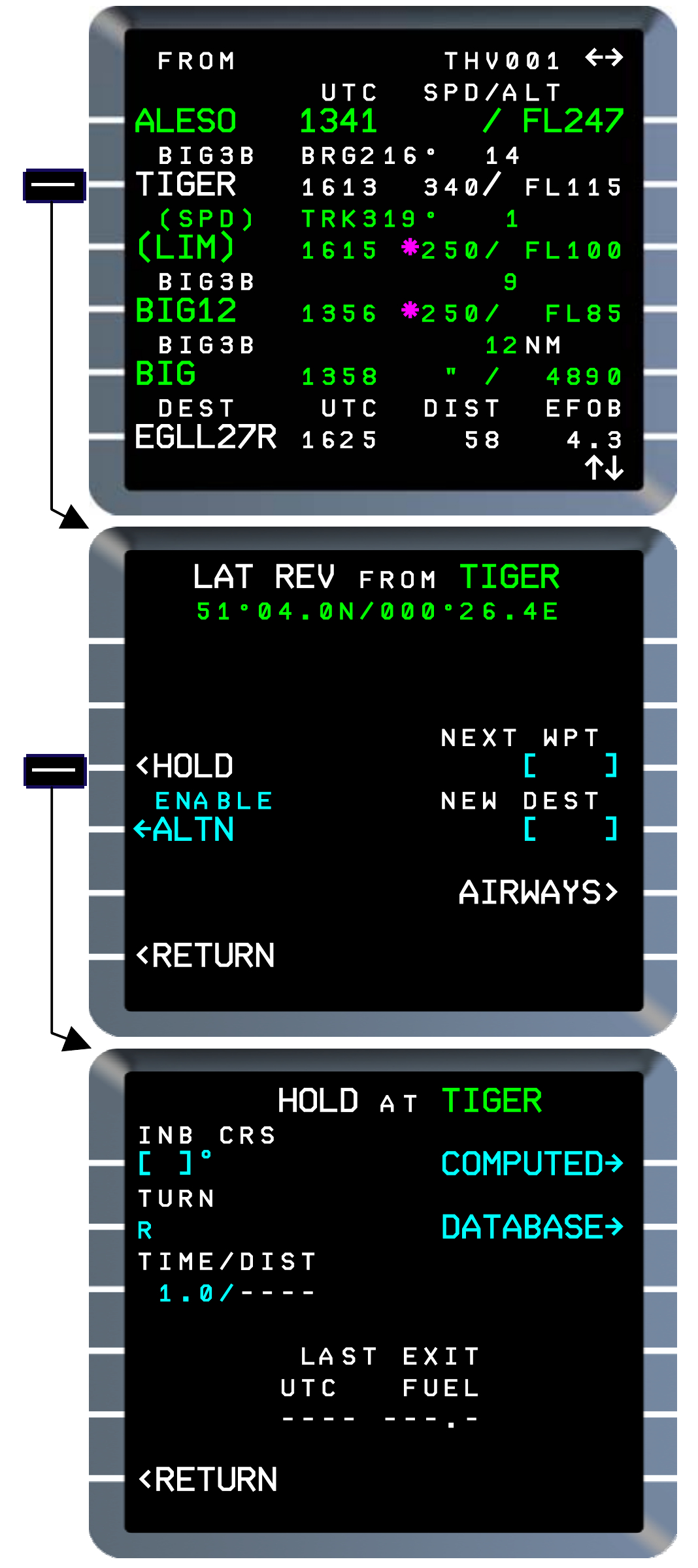
Manufacturer reference: lateral revision, hold selection and parameter page in Thales FMS2 REV1. Fenix V3 corroborates manual/database hold capability; the illustrated values and layout belong to this source standard. [66, PDF p. 357]