LONG-RANGE TWINS: RELIABILITY CHANGED THE ROUTE MAP
The number of engines mattered to more than maintenance bills. Extended-range approval allowed twins to fly routes farther from a suitable diversion airport, but approval depended on a defined aircraft standard and an operator able to meet the corresponding requirements. In its 2011 historical overview, Airbus dated the first ETOPS certification of the A310 and A300-600 to 1986, the A320 fly-by-wire approval to 1991 and early ETOPS approval for the A330 to 1994. These steps help explain the changing appeal of large twins. [195, PDF p. 5]
Read the chronology as an expansion of capability, not as permission for every example of a type. A historical diversion-time milestone is not a dispatch approval for an arbitrary aircraft or airline. It also helps explain why the A330 and A340 could share substantial design thinking yet follow different commercial paths: route restrictions, engine reliability and airline economics continued to change after the two programmes began. [195, ETOPS/EDTO overview; certified capability and operational requirements] [194, A330 Family development and operator applications]
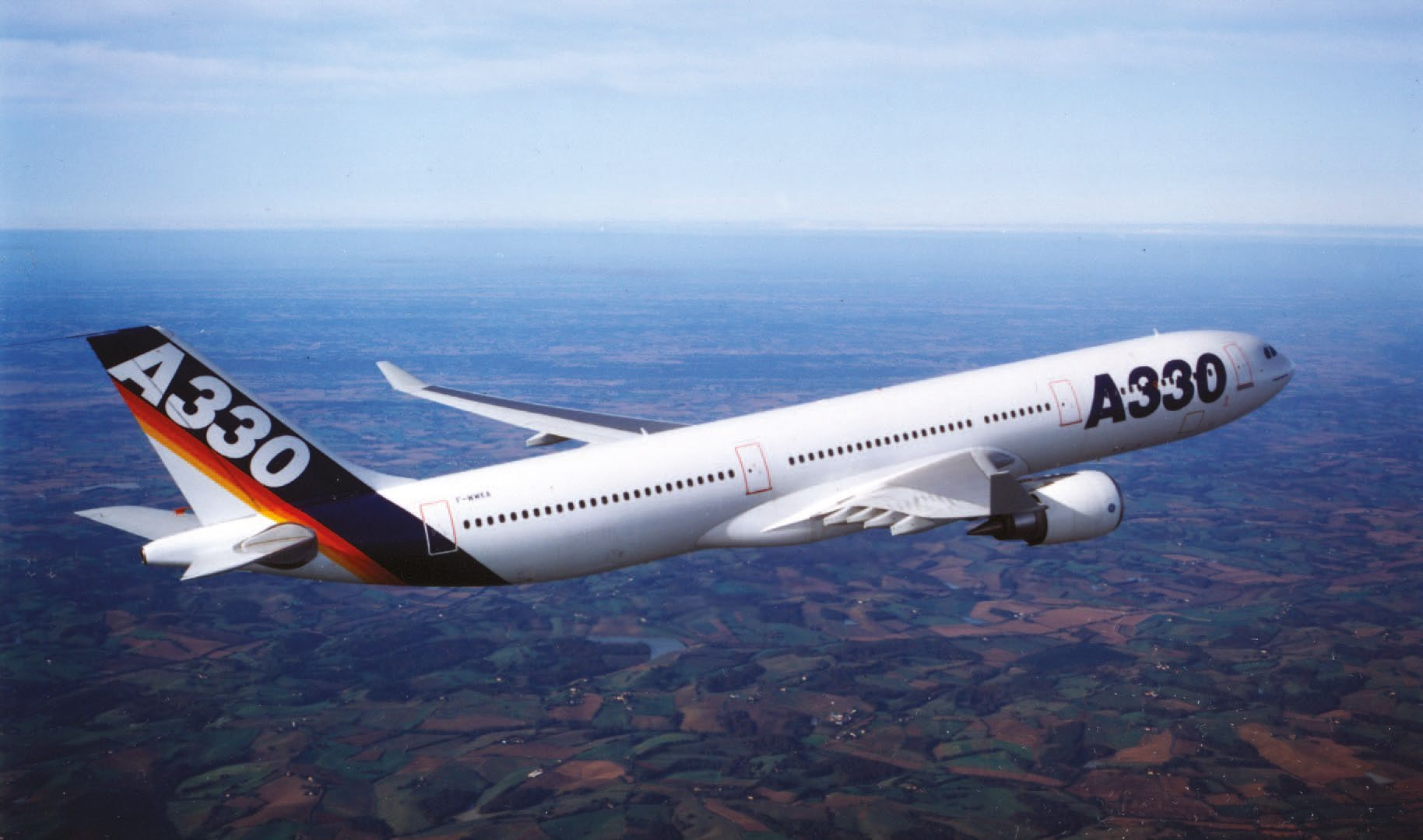
Original Airbus archive view of an A330. The twin-engine aircraft shared programme roots with the four-engine A340. Image: Airbus heritage collection; credits in source p.48. [170, PDF p. 39]