COMMONALITY: A FLEET IDEA WITH OPERATIONAL LIMITS
Airbus developed commonality across flight decks, control philosophy and training. Its 2016 retrospective describes the A320 as the cornerstone of this approach and explains how experience with one fly-by-wire type could reduce the training required for another. The aim was greater fleet flexibility and a lower burden when introducing related aircraft. A similar cockpit still requires differences knowledge and appropriate qualification; commonality did not make all Airbus types one aeroplane. [191, Aircraft-family commonality]
The same engine family can also evolve through improvements and new applications. IAE reported the V2500 passing 300 million engine flight hours in 2025, including service on the A320ceo family and passenger-to-freighter conversions. That milestone describes accumulated service, not a new aircraft operating limit. It shows how a mature propulsion programme can remain important after attention has shifted to newer engine generations. [192, 9 April 2025 service milestone]
A simulator session demonstrates the distinction. FCU interaction can be familiar while fuel architecture, engine indications, mass limits or flight-control detail differs. The productive question is which knowledge transfers and which must be replaced. This companion shares explanations where principles are shared and uses explicit variant sections for differences, rather than repeating one generic checklist under three names. [166, General, engine controls, fuel and automatic-flight chapters]
A concrete example shows what commonality requires in practice. On 14 October 2021, Airbus announced Japanese approval for Mixed Fleet Flying between the A320 and A380, with ANA set to introduce it. That was a specific approval, involving defined training and operating arrangements. Similar cockpit ideas create opportunities; approval turns an opportunity into an authorised operation. [193, Opening approval announcement and Mixed Fleet Flying explanation]
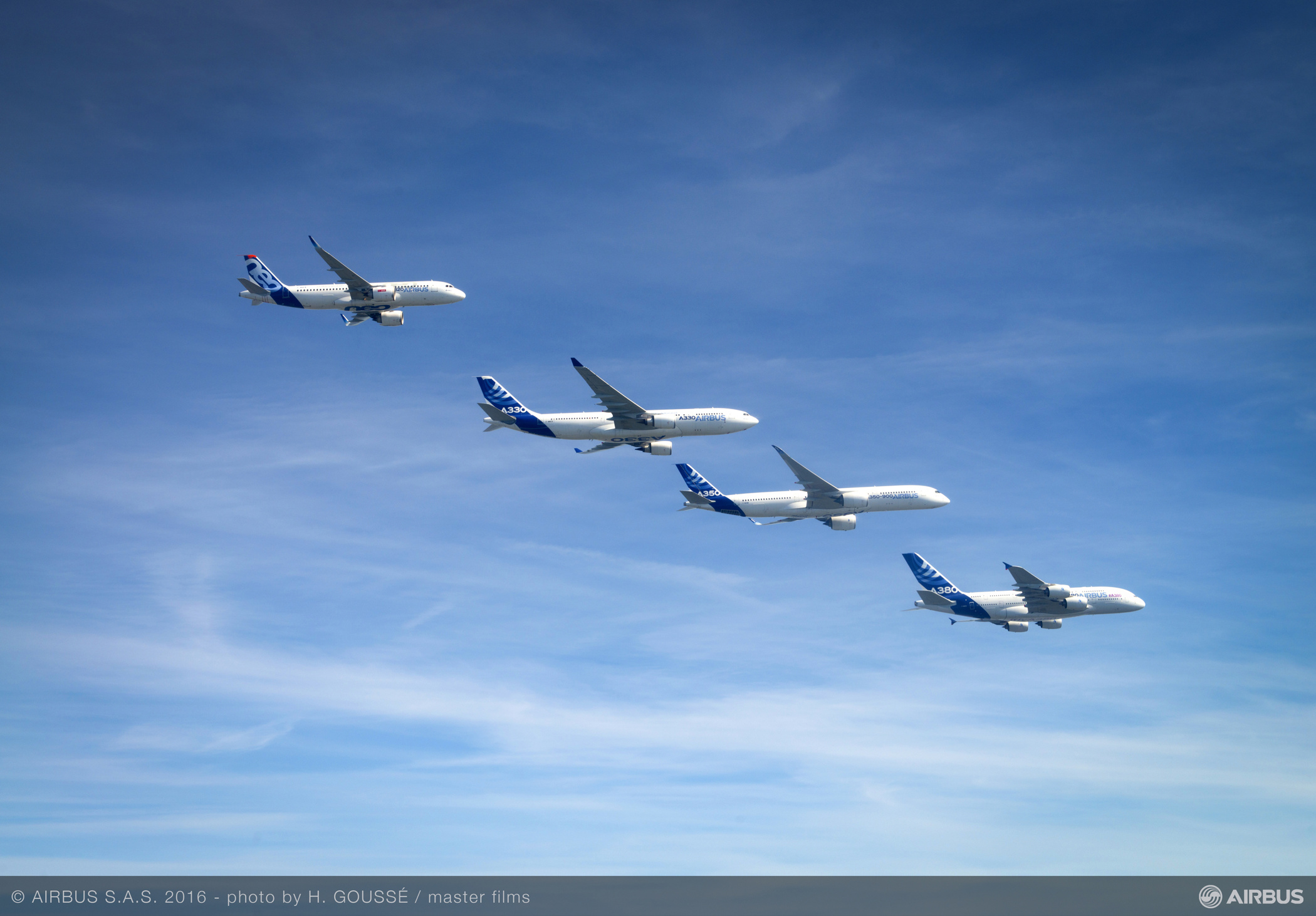
A320neo, A330-200, A350-900 and A380 in an Airbus family formation. This illustrates real-world commonality across families. Photograph: Airbus S.A.S. 2016, H. Gousse/master films. [191, Related asset: Family Flight]