WINGTIP, STRUCTURAL AND EQUIPMENT STANDARDS
A wingtip choice belongs to an aerodynamic configuration, not merely to the exterior artwork. The official Sharklet development material describes airframe-specific aerodynamic and flight-control work, while the family announcement explains the A321’s enlarged wing and double-slotted trailing-edge flaps. These changes affect lift, drag and the response to configuration changes. The A319 and A321 also share lift-improvement features that are not automatically implied by every A320 ceo. A common flap-lever label therefore need not describe identical physical geometry or identical performance across the family. [51, Sharklet aerodynamic and flight-control development] [87, PDF p. 53,]
The longer A321 changes the relationship between cockpit, main gear and tail. At the same cockpit ground track, the main gear follows a different turn geometry; during rotation or flare, the fuselage can approach the runway with a different clearance margin. These are geometric consequences, not reasons to invent an A321 pitch target from an A320 illustration. The shorter A319 likewise combines its own mass, lift and thrust characteristics. For comparisons, keep loading, atmospheric conditions and the selected thrust rating identifiable so airframe differences are not confused with changed test conditions. [21, PDF pp. 108–110] [55, Section 2-2-0, general dimensions] [57, Section 2-2-0, general dimensions]
The current configuration register includes automatic AC-essential transfer, ADIRS-panel type, backup speed scale, brake fans, ice detection, standby instruments, hydraulic steering source, start-pack inhibition and other per-livery settings. MSFS2024 engine/wing/cabin tags and MSFS2020 base-container detection are distinct configuration mechanisms. Their presence documents choices, not a universal option set for every model/platform. Preserve the loaded configuration when investigating behaviour; an apparently identical repaint can carry different systems options. [70]
Separate a change in presentation from a change in function. A new-style audio panel alters the crew interface; a different hydraulic steering source changes a dependency; a default takeoff-performance packs setting changes an initial calculation assumption. The correct comparison asks which mechanism changed and which observations should follow. Keep a configuration record beside the performance data and failure scenario. It allows a repeatable investigation and prevents a cosmetic feature, historical brochure or another user’s airframe from becoming accidental authority for the installed aircraft. [70, Available Options, effectivity descriptions] [23, PDF pp. 1010–1033]
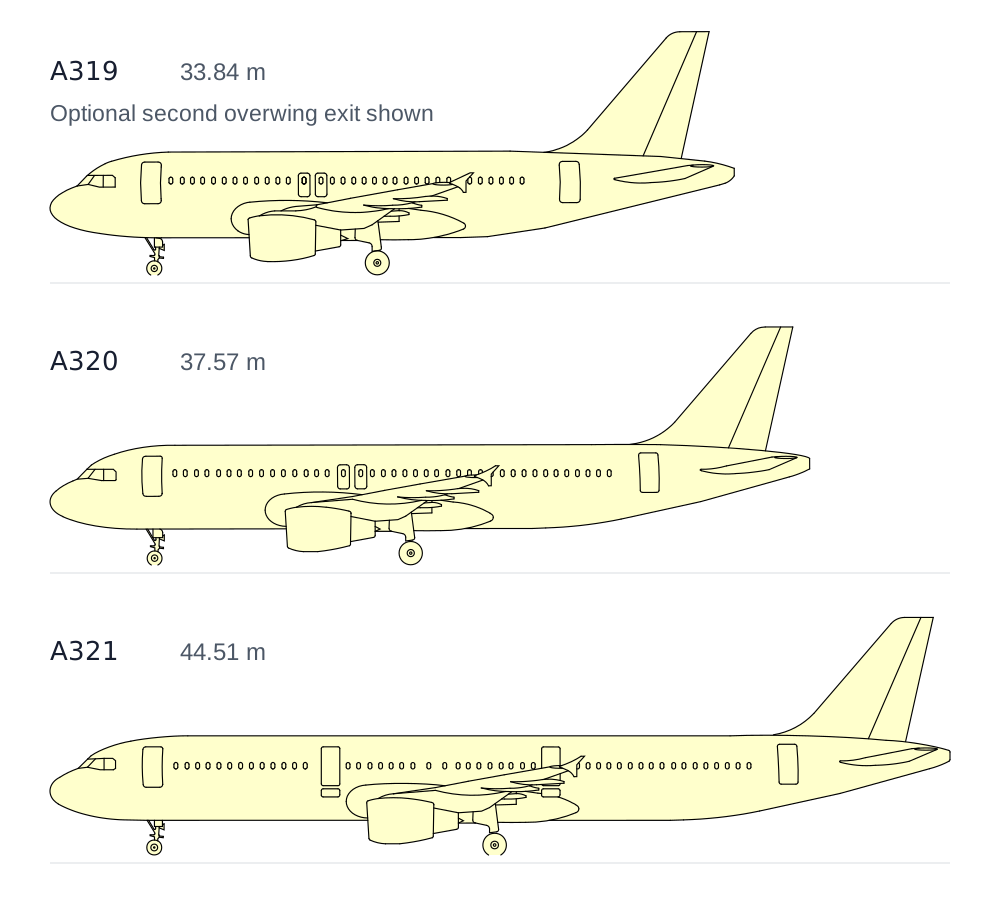
Airbus ceo side profiles at one length scale: A319 33.84 m, A320 37.57 m, A321 44.51 m. Original manufacturer contours. The A319 source shows the optional second overwing exit. [55, PDF p. 42] [56, PDF p. 44] [57, PDF p. 67]