PRESSURE CONTROLLERS, OUTFLOW AND DESTINATION REFERENCE
The pressure schedule is produced by controlling air leaving a supplied pressure vessel. Packs provide the air; the outflow valve regulates its escape. The supplied architecture has two cabin-pressure controllers, one outflow-valve actuator with separate automatic and manual motors, and safety valves. Those functions should remain distinct. An automatic controller commands the outflow valve; a safety valve provides protection against pressure conditions beyond the normal control role. The presence of a manual motor does not make manual selection the normal response to every unusual indication. [69, PDF pp. 21–22]
The automatic sequence includes ground operation, takeoff prepressurisation, flight scheduling and controlled depressurisation after landing. These phases explain why the outflow valve and cabin trend need not behave identically at the stand, during rotation and after touchdown. The controller uses relevant air-data, flight/ground and destination information. A correct landing-elevation reference belongs to the intended destination, not to a previous flight or an airport-height guess. A destination revision can therefore require a pressure-reference review even though no pressure-panel selector was moved. [69, PDF pp. 21–22] [23, PDF pp. 1014, 1020, 1082–1084]
Cabin altitude, cabin vertical speed and differential pressure describe condition, rate and pressure difference. Their combination is more diagnostic than an isolated value. A normal-looking cabin altitude with an unexpected rate is a different observation from a stable but inappropriate destination reference. Outflow-valve indication adds evidence about the control response. During a supply loss, the pressure trend reflects the complete containment and inflow/outflow arrangement; a temperature selector cannot correct that underlying balance. [69, PDF pp. 17–18, 21–22]
The pressure controls include automatic/manual selection and landing-elevation selection, while ditching has its own closure purpose. Treat these as functions within a defined procedure, not interchangeable methods of making a number decrease. Manual outflow control changes the relationship between crew action and cabin rate, and removes the normal controller’s scheduling role. The older source also describes limitations and safety thresholds that are option-dependent. Preserve their source effectivity rather than publishing them as universal Fenix values, especially for high-altitude-airport modifications and different oxygen/cabin-pressure standards. [69, PDF pp. 21–22] [23, PDF pp. 1014, 1020]
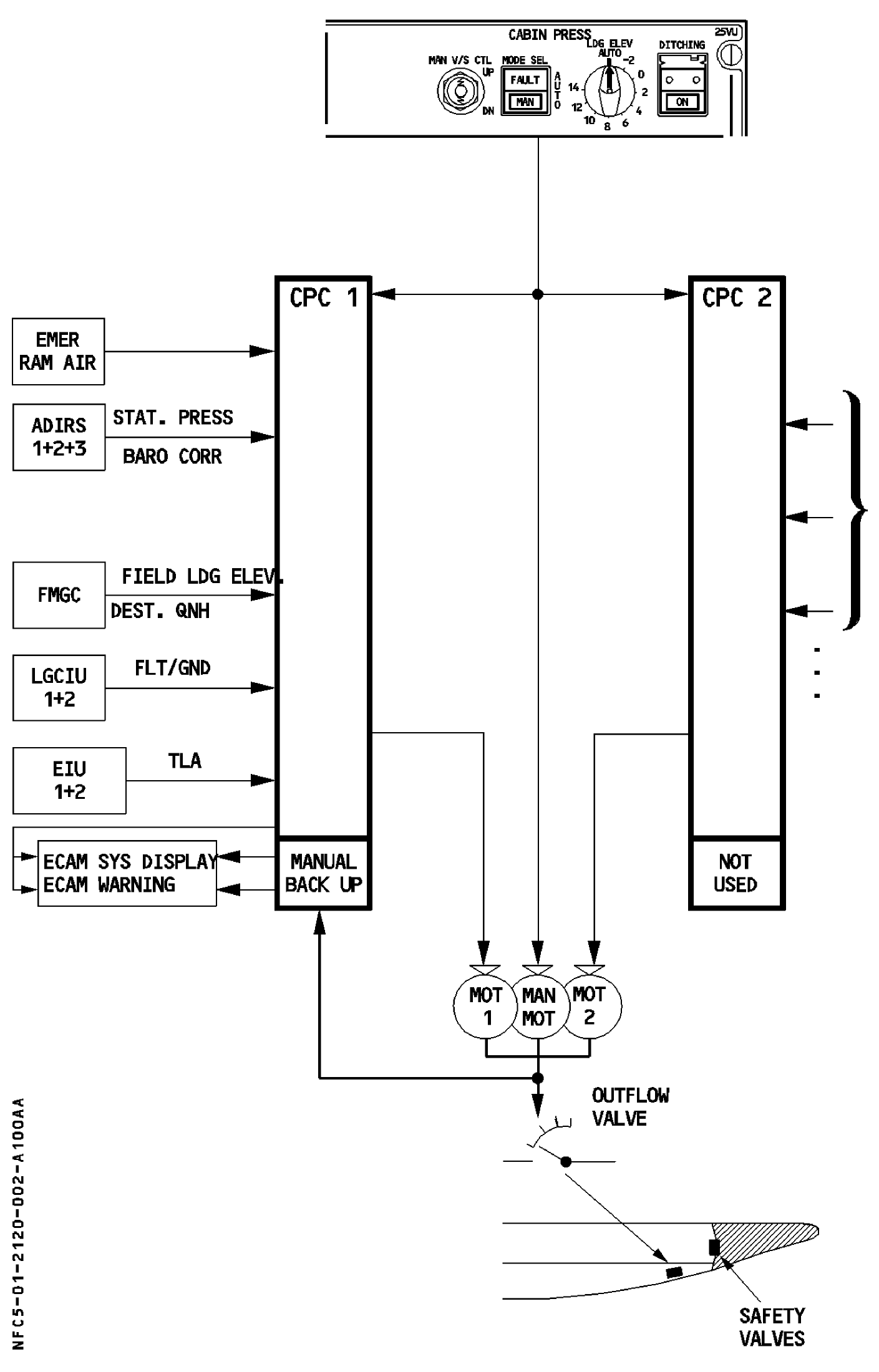
Cabin-pressure controllers, inputs and outflow-valve control. [69, PDF p. 22]