A321 JET-PUMP TRANSFER AND ADDITIONAL CENTER TANKS
The A321 reference fuel system uses a different wing-storage and centre-transfer arrangement from the A319/A320 standard just described. The Airbus briefing identifies a single wing tank in place of inner/outer cells and centre fuel transferred into the wings rather than directly providing the same pump-fed centre-engine supply. That difference is visible on both the system page and the cockpit controls. The original Fenix illustrations retain the distinction between centre PUMP controls on A319/A320 and centre L XFR/R XFR transfer controls on A321. [87, PDF pp. 100–103] [58, Original fuel-panel and FUEL-page comparison illustrations]
In the briefing’s A321 arrangement, flow taken from the wing pumps drives jet pumps that move centre-tank fuel into the wing tanks. A jet pump uses the energy of a motive flow rather than functioning like an electrically driven centre booster pump. Transfer-valve logic limits transfer when the receiving condition or centre quantity requires it. This creates a dependency on the motive/feed arrangement: centre fuel present is not, by itself, proof that the transfer stage is functioning or that the fuel is immediately available in the required feed location. [87, PDF pp. 100–101]
Fenix’s current product description supports up to two Additional Center Tanks on A321; its configuration register identifies zero, one or two installed tanks. These choices affect the aircraft configuration and loading plan, not merely the displayed capacity. An ACT-equipped preparation must account for the additional storage/transfer stage and the cargo-space implications documented by the developer. The public product/configuration sources do not provide a complete build-specific ACT valve, pressurisation and failure specification. That detail remains separate from the verified fact that the option is offered. [52, Current What’s Included? ACT support] [70, Available Options: fnx_act_count] [51, ACT installation and aft-cargo implications]
For an advanced comparison, establish installed tank count, quantity by tank, transfer indications, receiving-tank trend and engine consumption. Distinguish a stopped transfer because its normal receiving condition has been reached from unavailable transfer with required fuel still stranded upstream. Review the actual option and applicable fuel procedure before altering the configuration. A longer-range planning result should not be obtained by entering extra block fuel into the MCDU while leaving the aircraft’s tank installation or loading unchanged. Capacity, usable distribution, mass, centre of gravity and performance all belong to the same physical aircraft. [87, PDF pp. 100–103] [66, PDF pp. 123–124] [51, Additional Center Tank configuration discussion]
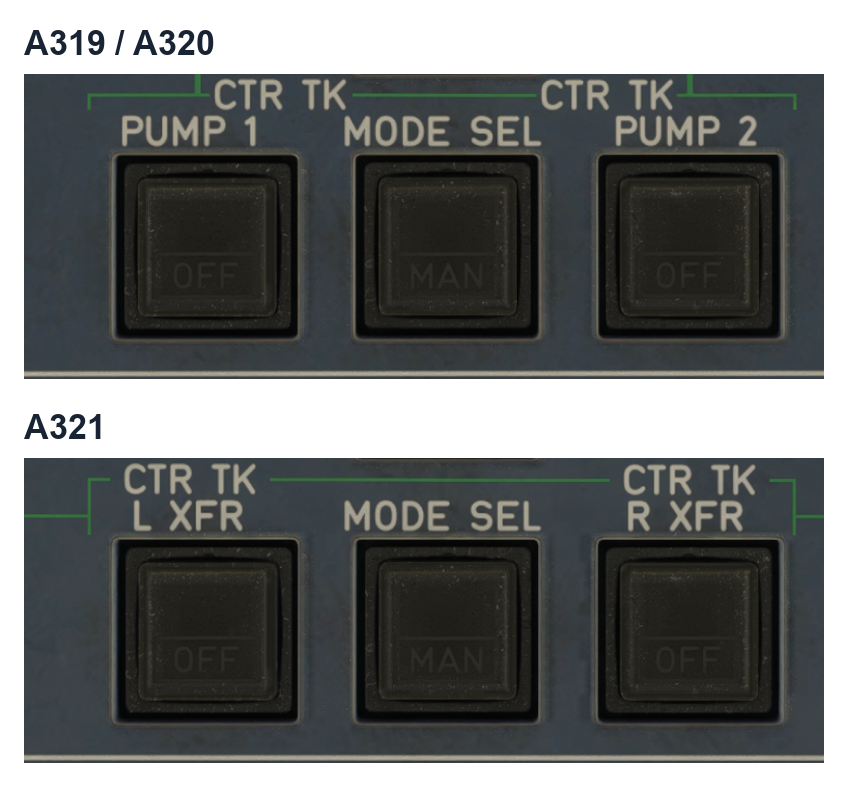
Original Fenix centre-tank controls, enlarged without changing their pixels: PUMP 1/2 on A319/A320; L XFR/R XFR on A321. [58, Illustrations in the family-differences article]