ALONG-TRACK POINTS AND PILOT-ROUTE STORAGE
A place/distance point along the flight plan differs from a PBD point on a bearing from a reference. Its position depends on the route geometry around the named fix. The source abbreviates these along-track points as PDnn. The sign, revise point and existing route matter, so an entry that contains a familiar fix and distance still needs inspection on the actual route. [66, PDF pp. 451-464,420-423,654,671]
1. Identify the route-relative task. Establish whether the intended point lies before or after the reference along the route. The source's ADABI/-20 example creates a point twenty nautical miles before ADABI along that route. Its separate step-altitude example 360/ADABI/20 places a step twenty miles after ADABI. These document geometry and signed-distance meaning, not current fixes, a cruise level or clearance for Frankfurt-Heathrow. [66, PDF pp. 451-464,420-423,654,671]
2. Verify the accepted position. Inspect the generated point relative to the reference, nearby turns and intended along-track distance. Compare full coordinates if the shortened identifier is unclear. A point ten miles along a turning route need not coincide with one ten miles on a straight radial. If PLACE/WPT MISMATCH appears, re-establish the selected revise point and intended reference instead of merely changing the numeric sign. [66, PDF pp. 451-464,420-423,654,671]
3. Store only deliberately reusable data. The source's pilot-waypoint pages allow creation, review and deletion of stored records. Use the intended IDENT and complete definition, then STORE when the supported interface requires it. Distinguish a point temporarily created for a route revision from a deliberately stored record. Memory capacities and automatic allocation in the 2004 guide are software-standard details, not guaranteed current Fenix limits. [66, PDF pp. 451-464,420-423,654,671]
4. Review stored routes before reuse. A route record is useful for a later initialization, but it may not preserve every temporary or FM-created element and terminal-area modification. The source includes route-modified warnings for such cases. Inspect a retrieved route against the current database and intended procedure rather than treating the saved name as a complete snapshot of every earlier cockpit state. [66, PDF pp. 451-464,420-423,654,671]
5. Protect active references during cleanup. Before deleting pilot data, identify whether ACTIVE, TMPY or SEC uses it. After changing a definition or retrieving a route, repeat the geometry and constraint review. A clean data list is less important than a correct active flight. If storage behaviour differs from the documented standard, record the actual supported result and avoid assuming that a partially retained record remains safe to reuse. [66, PDF pp. 451-464,420-423,654,671]
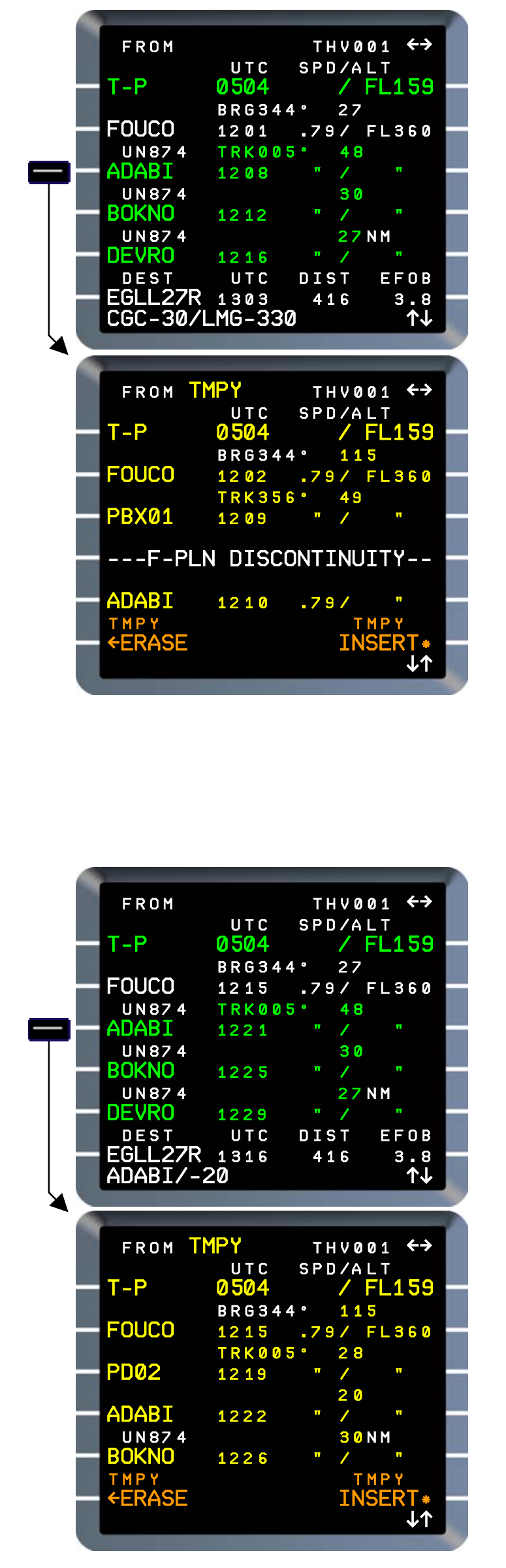
Manufacturer reference: PB/PB and PLACE/DIST point definitions in Thales FMS2 REV1. The CGC/LMG/ADABI examples illustrate source geometry only; exact accepted V3 format and generated identities must be read on the loaded unit. [66, PDF p. 654]