SHUTDOWN, POWER TRANSFER AND THE NEXT SECTOR
Before stopping the engines, arrange the electrical supply that will keep the aircraft powered afterwards. The APU must be AVAIL with its generator enabled, or suitable external power must be available and selected as required. A ready replacement source is different from a source currently feeding the electrical buses. Normally operating engine generators retain priority for their supplies, so the APU can be ready while the engines still carry the load. Watch the ELEC page to understand the source actually in use. The handover becomes visible as the engine generators go offline and the prepared supply takes over. [22, PDF p. 6] [14, PDF p. 1161]
With the aircraft properly secured and the required engine conditions satisfied, carry out the engine-master shutdown sequence. Monitor engine rundown and continuing electrical supply on ECAM, then confirm the required cabin-air supply and other system changes. Electricity and pneumatic air are different services; a successful electrical handover does not establish the air-conditioning supply. Complete the light and sign selections and coordinate the safe door, slide and ground-access sequence. The stand is now becoming a workplace around the aircraft. Our part is to leave the systems and cabin state suitable for that work and confirm the results as the engines wind down. [14, PDF pp. 1161-1165]
For a turnaround, retain the services needed for the next sector and start fresh preparation with newly verified data. A different load or runway belongs in a new calculation, even if the cockpit still looks much as it did at Frankfurt. For full securing, follow the final shutdown procedure through the required APU shutdown and final electrical state. Battery selections belong at the appropriate end of that sequence, with the preceding shutdown completed. It is worth watching the whole handover on a practice flight: source readiness, generator removal, continuing bus supply and final securing become distinct events with indications we can recognise. [14, PDF p. 1166] [63, PDF p. 7]
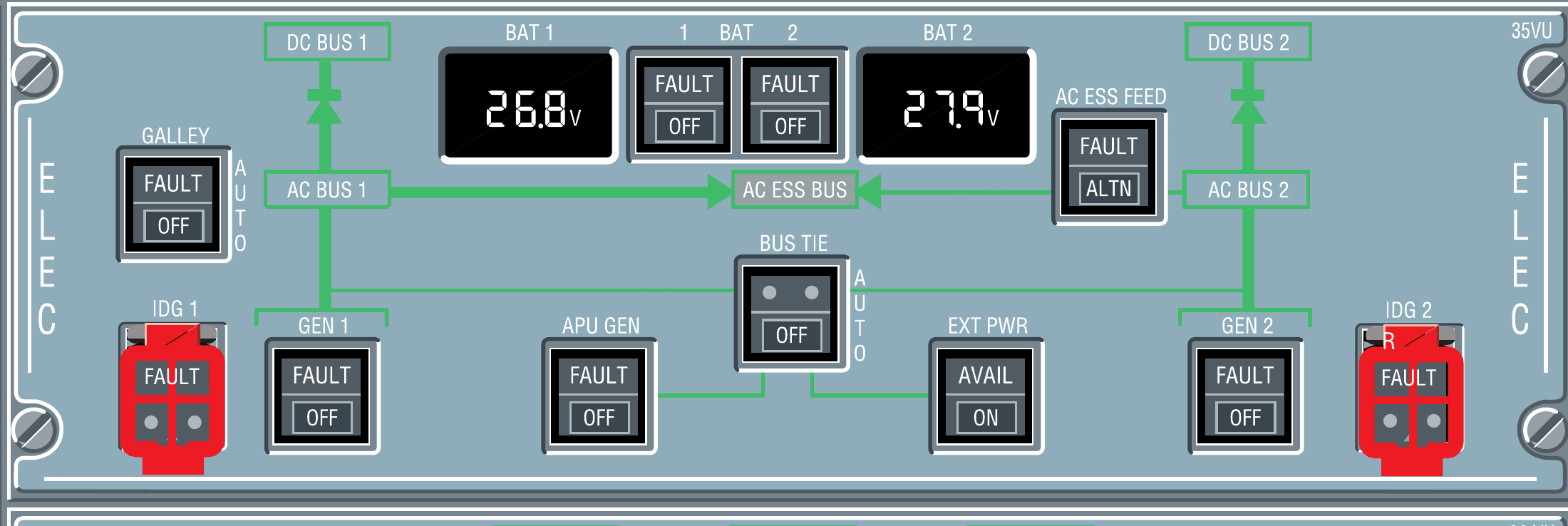
BAT 1, BAT 2, APU GEN and EXT PWR in the original overhead reference. [23, PDF p. 1]
IN PRACTICE: Park without losing power halfway through the handover
Before you begin: The aircraft is stopped at the correct stand, the engine idle-cooling requirement is met and the intended replacement electrical source is available.
1. Secure the aircraft by a verified means
Action. Check parking-brake accumulator pressure and brake temperatures. In the normal-temperature parking case, set PARKING BRK ON and check the brake pressures on the triple indicator; confirm the required chock arrangement before engine shutdown.
Check. The aircraft is held securely; a handle position alone has not been substituted for available pressure or effective chocks. [14, PDF pp. 1161-1165] [13, PDF pp. 201-202]
2. Prepare the electrical source before removing the engines
Action. For external power, confirm AVAIL and select EXT PWR ON. For APU power, confirm APU AVAIL and the normal generator arrangement. Read ELEC with engine-generator priority still in mind.
Check. The replacement source is ready. Running engine generators may still be supplying the buses because their priority is higher. [14, PDF p. 1161] [14, PDF pp. 1161-1165]
3. Prepare the required air supply
Action. If the APU will supply cabin air after shutdown, select its bleed supply at the appropriate point in the normal parking sequence. Check the resulting air-conditioning supply arrangement.
Check. The cabin air supply can continue through shutdown, separately from the electrical source choice. [14, PDF pp. 1161-1165]
4. Shut the engines down and watch the transfer
Action. Set ENG MASTER 1 and 2 to OFF in the normal parking flow. Watch engine parameters decrease, then confirm the new electrical source supplying the buses.
Check. The engines shut down and the prepared APU or external source takes the electrical load. Displays and essential aircraft services remain powered. [14, PDF pp. 1161-1165] [14, PDF p. 1161]
5. Make the parked state visible to the cabin and ground
Action. Set the appropriate seat-belt signs and exterior lights, coordinate door/slide and ground-service actions, and complete the Parking checklist.
Check. The cabin and ground operation recognise the parked state, and doors are handled in coordination with their slide state. [14, PDF pp. 1161-1165]
6. Choose turnaround or securing deliberately
Action. For another sector, retain the required power and update the new flight preparation. If finishing the session, continue with the separate securing flow, including the APU/power-down sequence, rather than stopping halfway through parking.
Check. The aircraft is left in an intentional state: ready for a turnaround or fully secured through its own sequence. [14, PDF pp. 1161-1165] [14, PDF p. 1166]
Complete when: Parking and power transfer are complete, with the aircraft secured and either the turnaround or securing path clearly selected.