STABILISATION AND THE DECISION TO CONTINUE
A stable approach is an aircraft arriving in a condition we can continue to monitor with small, understood corrections. Look at the runway and flight path, landing configuration, speed, thrust and completion of the checks together. A satisfactory speed does not settle a large path error, and a centred path does not complete an unfinished landing configuration. Keep checking the combination as the runway gets closer. The point of stabilisation is practical: it leaves room to notice a change and make a clear decision, instead of spending the final approach trying to catch up with the aircraft. [13, PDF pp. 149-158]
For this exercise, use a conservative gate of stable by 1,000 feet above the aerodrome, with that condition maintained afterwards. This is the criterion chosen for our practice flight. The height is relative to the aerodrome, so it should not be mistaken for a fixed altimeter indication at every airport. Other operations distinguish conditions and company requirements; use their applicable procedure when practising them. Before starting the approach, decide what meeting this exercise gate looks like and what you will do if it is missed. A stated gate is useful when it produces a timely decision.
If the required approach conditions cannot be achieved or maintained, go around. Practise that option deliberately so that it becomes a familiar flight path with a sequence you understand. The decision then has somewhere definite to lead: thrust, guidance, configuration and the missed approach have already been considered. An approach can also deteriorate after passing the gate, so continue monitoring rather than treating the earlier check as a guarantee. Our Frankfurt-Heathrow exercise is complete when we have managed the flight sensibly, whether the first approach ends in a landing or in another circuit through the arrival plan. [13, PDF pp. 197-200]
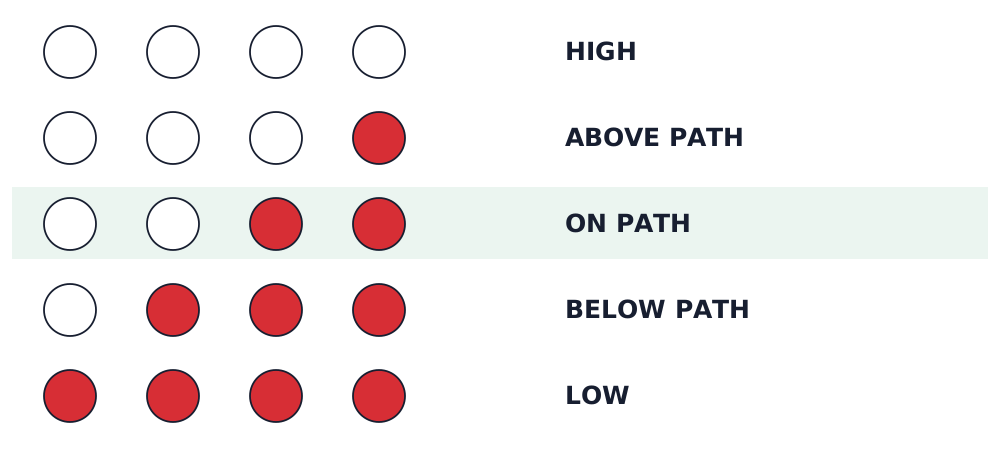
PAPI as seen on approach: four lamps, with white at left and red at right. Two white/two red indicates the visual path; use the published approach geometry. [13, PDF p. 185]
IN PRACTICE: Make the stability check a decision, not a recital
Before you begin: The approach has reached the applicable stabilisation gate from the operating procedure. The aircraft is expected to be fully configured and ready to land.
1. Check where the aircraft is going
Action. Compare the runway alignment, lateral deviation and vertical path with the intended approach. Look for a path that can be maintained with normal, small corrections.
Check. The aircraft is established on a usable landing path rather than converging late from a large deviation. [13, PDF pp. 149-158] [13, PDF pp. 197-200]
2. Check the speed trend, not just the instantaneous value
Action. Compare indicated speed with the required target and watch the trend. Include thrust response and the effect of wind changes.
Check. Speed is controlled and the aircraft is not arriving at the target while still rapidly accelerating or decelerating. [13, PDF pp. 149-158]
3. Check that the landing configuration is complete
Action. Confirm the gear, actual flap/slat configuration, spoilers and required landing checks.
Check. The aircraft is ready to touch down without a major configuration task still pending. [13, PDF pp. 149-158] [14, PDF pp. 1091-1110]
4. Check the energy and workload together
Action. Assess descent rate, thrust, required corrections and the work still unfinished. Confirm that the approach can continue without a rushed attempt to rescue it.
Check. The flight path, energy and remaining workload support a normal landing. [13, PDF pp. 149-158] [13, PDF pp. 197-200]
5. Act on the result
Action. If the approach meets the applicable stable criteria, continue monitoring. If it does not, initiate the normal go-around; at the minimum, also apply the required visual-reference decision.
Check. The stability check has led to the appropriate flight-path decision instead of becoming another item that was merely spoken. [13, PDF pp. 197-200] [13, PDF pp. 149-158]
Complete when: Continue only while the applicable stability and visual-reference conditions are met. A go-around is already the prepared alternative.