DESCENT MODES AND ENERGY MANAGEMENT
At the start of descent we have height and speed to give away, while still arriving at the right place in the right condition. Height, speed and remaining distance belong in the same picture. A shortcut leaves less track on which to descend; a wind change alters progress across the ground; a speed restriction can ask us to slow while still losing height. Look ahead at the next restrictions and clearance before changing a mode. Early in the descent there is room to make a measured adjustment and observe its effect. Near the airport, the same change may arrive with turns and configuration tasks attached. [13, PDF pp. 141-146]
DES is managed descent, working with the computed vertical profile. In normal automatic use, OP DES descends towards the selected altitude with idle thrust and pitch guidance controlling speed; it does not observe the managed altitude constraints. V/S requests a vertical speed: it tells the guidance the rate of climb or descent we want, rather than supplying a complete energy plan. A rate that seems attractive on the display can leave too much speed to lose later, or demand a response that the available thrust cannot sustain. Read the FMA, selected altitude and actual airspeed together, while monitoring route restrictions and the resulting path. [60, PDF pp. 3-4,10-12]
Keep checking whether the descent is producing the height and speed we need at the next useful point. If the route or clearance changes, revise that expectation. Speedbrakes can help shed excess energy within their operating conditions, but the aircraft still needs distance and time to slow. Watch the effect of an intervention before adding another large one. For our Heathrow arrival, it is helpful to say which restriction we are meeting next and what the aircraft should do afterwards. That turns a moving vertical profile into a sequence of understandable tasks, each with an expected result we can check. [13, PDF pp. 141-146]
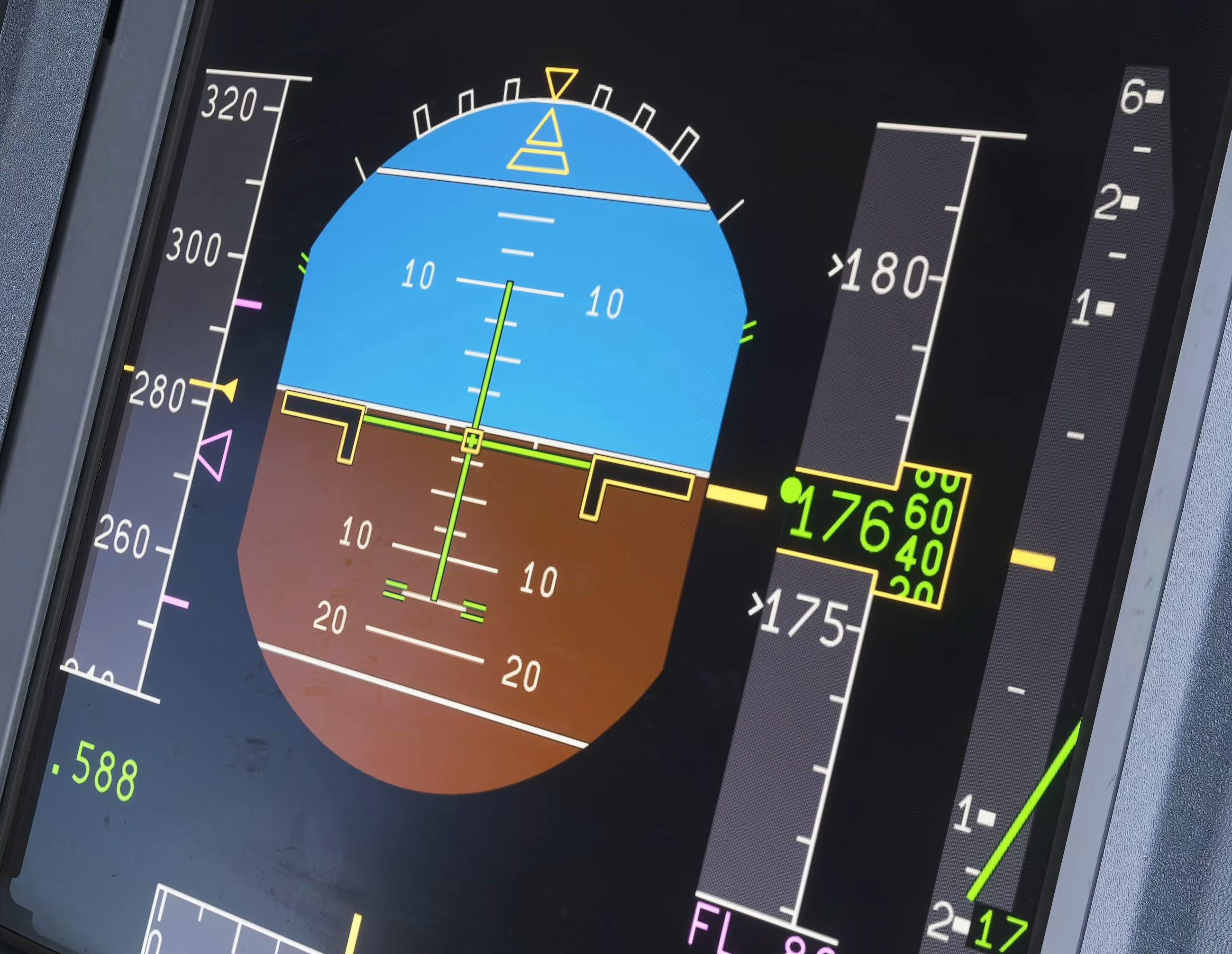
Original Fenix V3 VNAV display detail. The FMA is outside this crop, so the active vertical mode cannot be identified from this image. [2, Source illustration]
IN PRACTICE: Start the descent and watch the path stay believable
Before you begin: The arrival is prepared, the route and wind data are current, and ATC has cleared descent to a defined altitude or flight level.
1. Set the clearance before requesting a mode
Action. Turn the FCU altitude to the cleared level and read it back. At the cleared descent start, push the altitude knob for the planned managed descent along the route.
Check. DES is the requested managed mode and the FCU level remains the lower limit of the present clearance. [13, PDF pp. 141-146] [14, PDF pp. 1085-1090]
2. Read the aircraft response
Action. Check the FMA descent/thrust indications and the actual pitch, speed and vertical trend. Compare the vertical deviation with the computed profile.
Check. The aircraft has entered the expected descent and is moving towards the intended path; a button press alone has not been taken as confirmation. [13, PDF pp. 141-146]
3. Monitor constraints before they become urgent
Action. Look ahead at the next altitude and speed restrictions on F-PLN and the ND. Compare the predicted crossing with the chart and the active clearance.
Check. The next restriction remains achievable within the current path, speed and clearance. There is time to act if the prediction changes. [13, PDF pp. 141-146] [14, PDF pp. 1085-1090]
4. Manage excess energy while it is still manageable
Action. If the aircraft is high or fast, review the wind, speed and path picture early. Use permitted speedbrake as required, monitor the response, and retract it as the profile is recovered.
Check. The excess energy is reducing. The aircraft is not left applying additional thrust against forgotten speedbrake. [13, PDF pp. 141-146]
5. Treat vectors as a guidance change
Action. If ATC vectors the aircraft or a tactical descent is needed, set the cleared heading and level, select the appropriate vertical mode and read the FMA again. In OP DES, manually protect constraints that are no longer followed by the managed path.
Check. The selected guidance follows the new clearance, and the crew understands the change in automatic constraint handling. [13, PDF pp. 141-146]
6. Recheck after a shortcut or runway change
Action. After a direct clearance, route shortening or revised arrival, inspect the new distance, vertical deviation and next constraints. Update the route and prediction before relying on the old top-of-descent picture.
Check. The descent plan is based on the route now being flown, including the available distance to slow and configure. [13, PDF pp. 141-146] [14, PDF pp. 1085-1090]
Complete when: The descent remains within the clearance, its modes are understood, and the approach can be reached with a controllable energy state.