MANAGED CLIMB, OPEN CLIMB AND LEVEL CAPTURE
A climb needs a destination level, a speed strategy and a way of observing route restrictions. Managed CLB works with the flight-management climb and its programmed altitude constraints. OP CLB climbs towards the selected altitude without observing those constraints in the same way. In a normal automatic climb, climb thrust supplies the power while pitch guidance controls speed. The earlier FMA photograph shows OP CLB and NAV together: open vertical climb while still following the managed lateral route. ALT is armed for the coming level capture. Managed climb would show CLB. Choose the vertical mode to fit the clearance and constraints, and confirm it alongside the FCU altitude. [58, PDF pp. 2,5-9] [58, PDF pp. 8,19]
As we approach a target level, the aircraft needs to stop climbing and settle at that level. Watch the capture indication, the change in pitch and the eventual level-flight mode. The reduction in nose-up attitude is an expected part of levelling off, and thrust must also adjust to the new situation. Judge these changes together with the remaining altitude and actual airspeed. A normal capture has a recognisable progression; learning to watch it once is more useful than being surprised by the same movement on every flight. Keep the outside flight path in the picture when hand-flying the director guidance. [58, PDF p. 10]
When ATC clears us higher, enter the new altitude and request the intended climb mode, then check what changes on the FMA and in the aircraft. Consider any remaining departure constraints before choosing an open climb. The flight plan, clearance and selected level have to describe a compatible path. On the short Frankfurt-Heathrow sector, the climb may be stepped and arrival preparation may follow soon afterwards. Give each new clearance its own check rather than leaving a collection of half-completed selections behind. Once the aircraft is doing what we intended, there is time to prepare the next part of the flight. [13, PDF pp. 125-128]
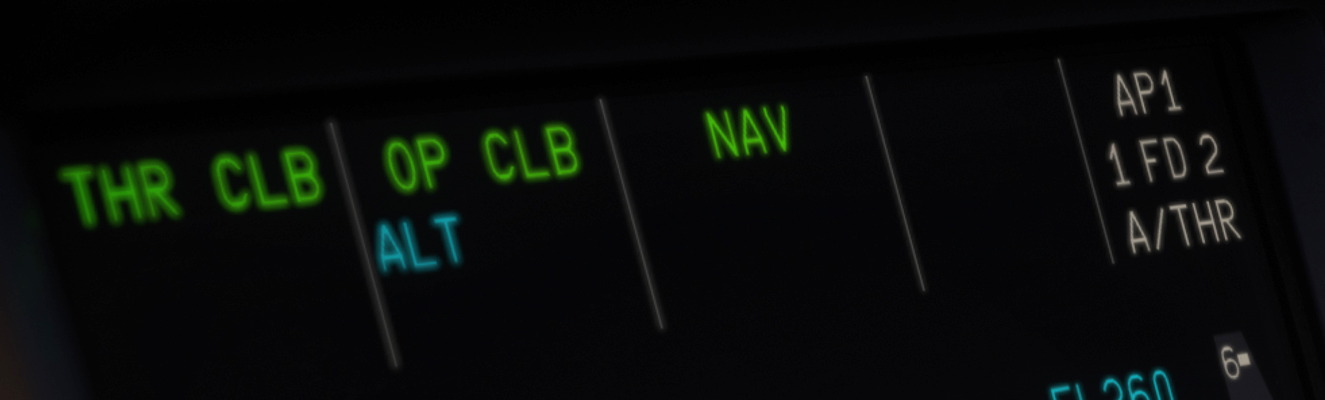
Detail of the actual Fenix FMA: THR CLB / OP CLB / NAV; ALT is armed. [1, Source illustration]
IN PRACTICE: Climb without losing the clearance in the automation
Before you begin: The aircraft is clean and established in the climb. The FCU shows the present cleared altitude, not an anticipated later clearance.
1. Read the vertical and lateral modes together
Action. Confirm the thrust levers in CL, autothrust active, and the intended climb/lateral guidance on the FMA. For a managed SID climb, look for CLB with NAV.
Check. The aircraft is using the climb logic that can respect the programmed altitude constraints along the route. [13, PDF pp. 125-128] [14, PDF pp. 1074-1077]
2. Apply a new altitude clearance explicitly
Action. Set the newly cleared altitude on the FCU. Push the altitude knob when continuing a managed climb along the flight plan, then read the resulting FMA.
Check. The altitude limit changes to the new clearance and CLB remains the intended managed mode. [13, PDF pp. 125-128] [14, PDF pp. 1074-1077]
3. Recognise a tactical climb as a different job
Action. If the clearance calls for a radar vector or an unrestricted climb, set the cleared heading/altitude and use the appropriate selected guidance. Read OP CLB if it is requested, and monitor any route constraints that it no longer follows automatically.
Check. The aircraft follows the tactical clearance. The selected mode is not being mistaken for managed constraint protection. [13, PDF pp. 125-128]
4. Check that the route keeps sequencing
Action. After a direct clearance or a vector, inspect the active leg and the next waypoint on the ND/F-PLN page. Rejoin or insert the cleared direct route deliberately.
Check. The aircraft is navigating to the intended next fix, and the displayed route still represents the clearance. [13, PDF pp. 125-128] [14, PDF pp. 1074-1077]
5. Read the level-off as it happens
Action. As the selected level approaches, watch ALT* and the subsequent level-flight indication. Check that the aircraft actually levels at the cleared altitude and that the pressure reference is correct.
Check. The capture completes without an unnoticed altitude-window error. Speed and thrust settle into the next phase. [14, PDF pp. 1074-1077] [13, PDF pp. 125-128]
6. Make the cruise entry agree with the clearance
Action. If the cleared cruise level differs from the level entered during preparation, update CRZ FL on the MCDU PROG page and compare the new predictions with the operational plan.
Check. The FMS knows the level actually being flown and can produce useful cruise speed, time and fuel predictions. [13, PDF pp. 129-140] [14, PDF pp. 1078-1081]
Complete when: The climb or level segment is correctly cleared, its modes are understood, and the FMS route and cruise level agree with the aircraft.