CONFIGURATION AND DECELERATION ON THE APPROACH
The landing wing configuration needs time and distance to develop. Slats and flaps alter the wing for lower-speed flight; gear extension adds another configuration change. Select each stage within its applicable limits and watch the actual indications as the surfaces or gear move. A lever position records our selection; the aircraft still has to reach that configuration. Follow the planned speed and configuration schedule so that each step arrives with room to check its result. Trying to do all of it close to the runway makes the final approach unnecessarily busy and leaves little room for an unexpected response. [53, PDF pp. 6-8]
Confirm gear down and locked, arm the ground spoilers and select the landing autobrake mode established by the plan. The original control-panel artwork shows MAX ON as its source example; use the planned landing choice for this arrival. Crosscheck the actual flap configuration against the landing calculation, and review the complete landing memo and cabin state. The autobrake selection prepares a deceleration function; the gear and high-lift indications establish physical configuration. Each contributes different evidence. Together they should describe the same landing that the calculation and briefing anticipated, including the intended runway condition and available stopping distance. [53, PDF pp. 6-8] [13, PDF pp. 149-158]
As the approach progresses, notice whether unfinished jobs are accumulating. A good glidepath can coexist with an aircraft that still needs to slow, configure and complete checks. Assess all of those demands while there is enough room to act. Our aim is to reach the planned stable condition and have attention available for monitoring it. If that is becoming impractical, change the plan and go around when required. On a practice flight, repeating a well-prepared approach is far more useful than dragging a collection of late selections towards touchdown and trying afterwards to work out which one mattered. [13, PDF pp. 149-158]
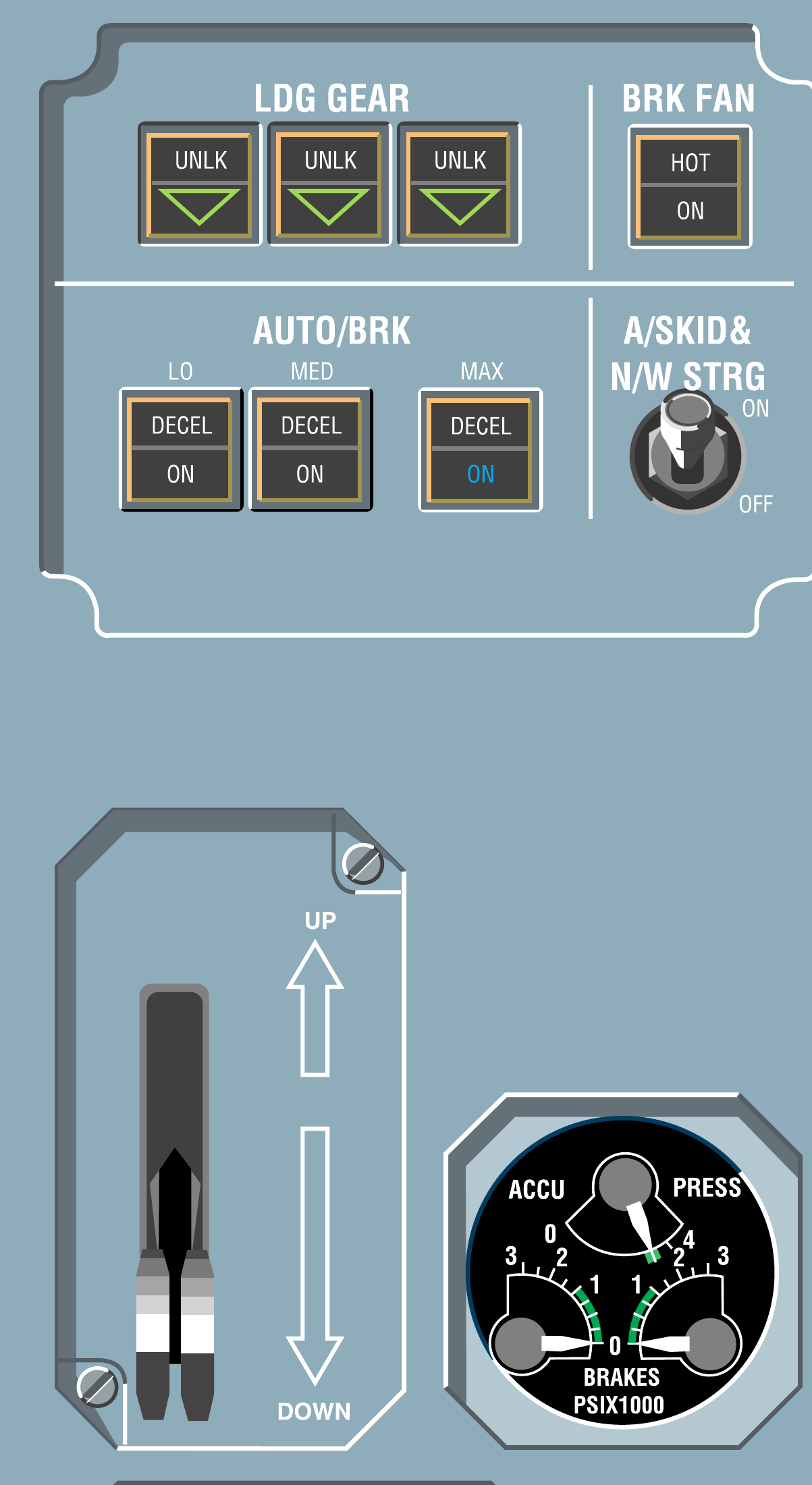
Original gear and AUTO BRK control reference. Source depiction: MAX ON. For landing, use the autobrake selection established for that landing. [61, PDF p. 1]
IN PRACTICE: Move from approach configuration to landing configuration
Before you begin: The aircraft is established on the arrival/approach with sufficient distance to decelerate. The landing configuration and stopping plan were briefed.
1. Confirm the approach phase and speed strategy
Action. Check that the FMS approach phase is active at the appropriate stage. Use the intended managed or selected speed, including any ATC speed instruction, while planning the remaining deceleration.
Check. The speed target belongs to the approach, and the crew still controls when the aircraft slows for configuration. [13, PDF pp. 149-158] [14, PDF pp. 1091-1110]
2. Extend one stage and watch it arrive
Action. Select the next flap/slat stage only within its permitted speed. Confirm actual movement and completion before the next stage is selected.
Check. The real high-lift configuration agrees with the lever selection and the available speed margin. [13, PDF pp. 149-158] [14, PDF pp. 1091-1110]
3. Lower the landing gear at the planned point
Action. Select the gear DOWN within its speed limits and confirm all three green down-and-locked indications. Include the effect of the added drag in the speed/path scan.
Check. The gear is positively down and locked, and the aircraft remains under control as drag increases. [14, PDF pp. 1091-1110] [13, PDF pp. 149-158]
4. Reach the calculated final configuration
Action. Select the planned landing flap configuration within limits, check actual surface travel and compare the final speed target with the current VAPP.
Check. The landing configuration and speed match the performance assessment and briefing. [13, PDF pp. 149-158] [14, PDF pp. 1091-1110]
5. Set the stopping systems
Action. Check ground spoilers armed, speedbrake retracted and the briefed landing autobrake selection. Confirm these states on their actual indications.
Check. The stopping configuration is prepared without carrying an unintended speedbrake extension into the final approach. [14, PDF pp. 1091-1110] [13, PDF pp. 185-196]
6. Complete the landing confirmation
Action. Obtain the required cabin-ready report, complete the Landing checklist and read the landing memo. Finish this work before the applicable stability gate.
Check. The cabin, gear, high-lift and stopping configuration have all reached their intended states while attention can return to flying the final approach. [14, PDF pp. 1091-1110] [13, PDF pp. 149-158]
Complete when: The aircraft is in its planned landing configuration, at a controlled approach speed, with the Landing checklist complete.