EDDF-EGLL: THE EXERCISE DATASET
We will prepare a flight from Frankfurt to London Heathrow in an A320 with CFM engines and wingtip fences. The airport identifiers are EDDF and EGLL. These four-letter codes are what we will enter in the MCDU. Our fictional flight identification is MC2026. Gatwick, EGKK, is the teaching alternate: the other airport included in this exercise's planning case. Keep this small set of identifiers together on the flight-data card.
The example uses cost index 20 and a planned cruise level of FL280. A flight level uses the standard pressure reference; FL280 represents 28,000 feet on that reference. The cost index is an input to the system's economic speed calculation. We will inspect the resulting speeds separately. These are exercise choices. The flight plan and clearance for an actual sector establish the route and level you will really use. [26, PDF p. 108]
Our example zero-fuel weight, ZFW, is 60.0 tonnes: the loaded aircraft's mass without usable fuel. Its corresponding centre of gravity, ZFWCG, is 27.0 percent MAC. MAC, mean aerodynamic chord, is a wing reference length; the percentage expresses how far along that reference the centre of gravity lies. Block fuel, the fuel aboard before taxi, is 6.0 tonnes. These entries have different meanings and units, even when the MCDU puts two of them together in one field. [26, PDF p. 123]
The teaching arithmetic is straightforward. Add 6.0 tonnes of fuel to the 60.0-tonne ZFW and the aircraft weighs 66.0 tonnes at the stand. Use 0.2 tonnes during taxi and the takeoff mass becomes 65.8. With the stated 2.4-tonne trip-fuel assumption, landing mass is 63.4 and fuel remaining is 3.4 tonnes. These figures let us practise a readback. They do not establish whether a real sector's fuel plan is adequate or force its computed trip fuel to be exactly 2.4 tonnes.
For manual airway entry, we use SOBRA Y180 BITBU Y181 DEMUL DCT DENUT L608 LOGAN. It comes from EUROCONTROL's May 2020 routing brief and is explicitly a historical keyboard exercise. The waypoint names mark places; the airway names describe connections between them. DCT marks a direct connection. We will use the sequence to learn how VIA and TO work. [47, PDF p. 1]
For a flight in a current database, use a current OFP and matching departure and arrival procedures. The historical exercise may contain an airway or connection that has changed. If the MCDU rejects it, check the current source instead of inventing a replacement. We can learn the keyboard from an older worked example while keeping the route we actually fly tied to current planning information and the actual clearance. [47, PDF p. 1]
The actual preparation also needs a runway, runway entry point and takeoff calculation. We leave those choices open until the correct information is available. The following exercises show where the resulting information belongs, with no invented runway, procedure, V-speed or FLEX temperature to be copied accidentally. [26, PDF pp. 113-114] [26, PDF pp. 125-128]
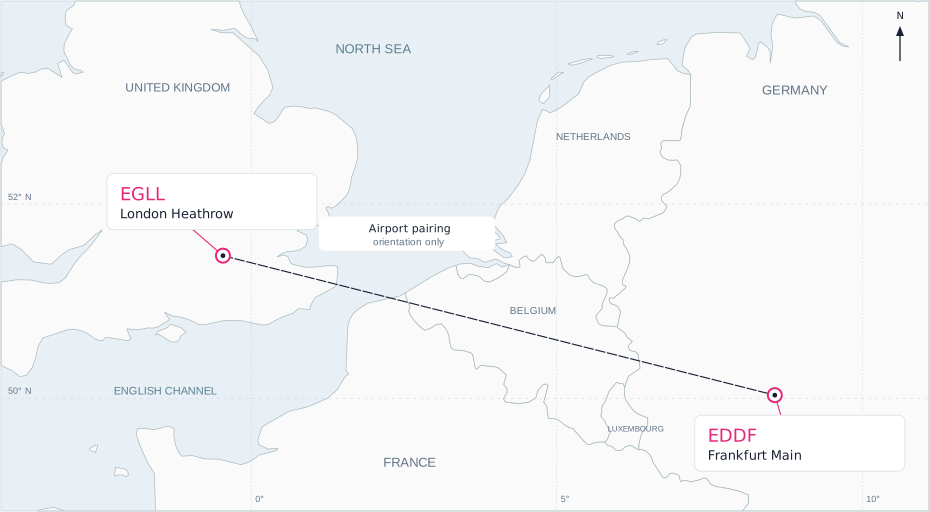
Frankfurt and London Heathrow in their geographic setting. The connector identifies the airport pair; it is not the filed route. [48, 1:50 million; version5.1.1] [49, AD2 EDDF1-1; AD2.2 item1] [50, EGLL AD2.2 item1]
IN PRACTICE: Set up the Frankfurt–Heathrow practice case
Before you begin: Use the stated fictional dataset for the exercise. For an actual simulator sector, obtain a current OFP, weather and charts and use their operational values.
1. Match the aircraft profile
Action. Select the A320 CFM with wingtip fences and the corresponding Fenix SimBrief profile. Compare the engine and wing option rather than accepting a generic A320 profile with a convenient name.
Check. The planned aircraft and loaded aircraft match. The official A320 CFM WTF profile is the appropriate starting point for this stated configuration. [51]
2. Write the sector identity
Action. On the exercise card, record EDDF to EGLL, alternate EGKK and fictional flight MC2026. Record cost index 20 and planned FL280 as exercise inputs. Use the actual date and weather for a live sector.
Check. A later MCDU readback has a clear independent reference. The exercise figures are not being presented as a dispatch recommendation for every flight.
3. Keep the mass and fuel arithmetic visible
Action. Record ZFW 60.0 tonnes, ZFWCG 27.0 percent MAC, block fuel 6.0 tonnes, taxi fuel 0.2 and planned trip fuel 2.4. Work out ramp, takeoff and landing mass before looking at predictions.
Check. The teaching arithmetic gives 66.0 tonnes at the stand, 65.8 at takeoff, 63.4 at landing and 3.4 tonnes of fuel at destination. These are planning references, not values to force into calculated fields.
4. Choose which route exercise you are doing
Action. For the historical airway-entry drill, use SOBRA Y180 BITBU Y181 DEMUL DCT DENUT L608 LOGAN. For a current flight, use the current OFP route and procedures that your active database actually contains.
Check. The 2020 routing example is labelled as such. A database rejection sends you back to the current route source; it does not invite an improvised substitute. [47, PDF p. 1]
5. Leave operational blanks genuinely open
Action. Obtain the actual departure runway, entry point, departure procedure and initial clearance. Prepare arrival choices from current planning information, then confirm them later. Do not fill missing runway or performance values from an illustration.
Check. The card contains the information actually available. There are no invented SID/STAR names, takeoff speeds, FLEX temperature or clearance altitudes. [26, PDF pp. 113-114] [26, PDF pp. 119-120] [26, PDF pp. 125-128]
Complete when: The aircraft, flight documents and practice card agree. Historical keyboard-route practice is clearly separated from the route you intend to fly today.