CHOOSE THE AIRCRAFT BEFORE PLANNING ITS FLIGHT
A319, A320 and A321 are members of the same Airbus family. Their cockpits have much in common, which is helpful when learning your way around. Their loading and takeoff calculations still belong to the particular aircraft. Our worked Frankfurt–Heathrow flight uses an A320 with CFM engines. Before preparing a plan, confirm that this is the model you have loaded in Fenix. A convincing cockpit can otherwise encourage you to overlook an aircraft-profile mismatch until much later. [10, The Fenix Simulations A319 & A321 for MSFS / What's Included?]
There is an engine choice as well as an airframe choice. CFM and IAE identify the two engine installations covered here. On the CFM installation, the main thrust reference is N1, a percentage indication of the engine's low-pressure rotating assembly speed. The IAE installation uses EPR, Engine Pressure Ratio, as its principal thrust reference. The indications and start procedures belong to that installation. A number remembered from a CFM example does not acquire the same meaning merely because you can see it on another engine's display. [1, What's Included?] [12, PDF p. 3] [13, PDF p. 59]
Now compare that aircraft with the profile used to produce the Operational Flight Plan, or OFP. The OFP contains planning information such as the route, fuel and masses. Its aircraft profile should match the airframe, engine and wingtip option you intend to fly. Make this comparison before importing a saved plan and accepting its predictions. The route may look perfectly sensible while the performance assumptions describe a different aircraft. Finding that at the gate is pleasantly uneventful compared with finding it during takeoff preparation. [10, What's Included?] [14, PDF pp. 1024–1025]
You will also see the family called ceo, short for Current Engine Option, to distinguish this engine generation from the later neo family. That historical naming can look odd on a modern simulator package. A large Sharklet at the wingtip does not by itself make an aircraft a neo; the actual engine and airframe configuration are what matter. Use the illustrations to recognise the family shapes, then check the configuration in the simulator and planner rather than choosing by appearance alone. [10, What's Included?] [9, paragraphs on wingtip and cockpit-equipment changes]
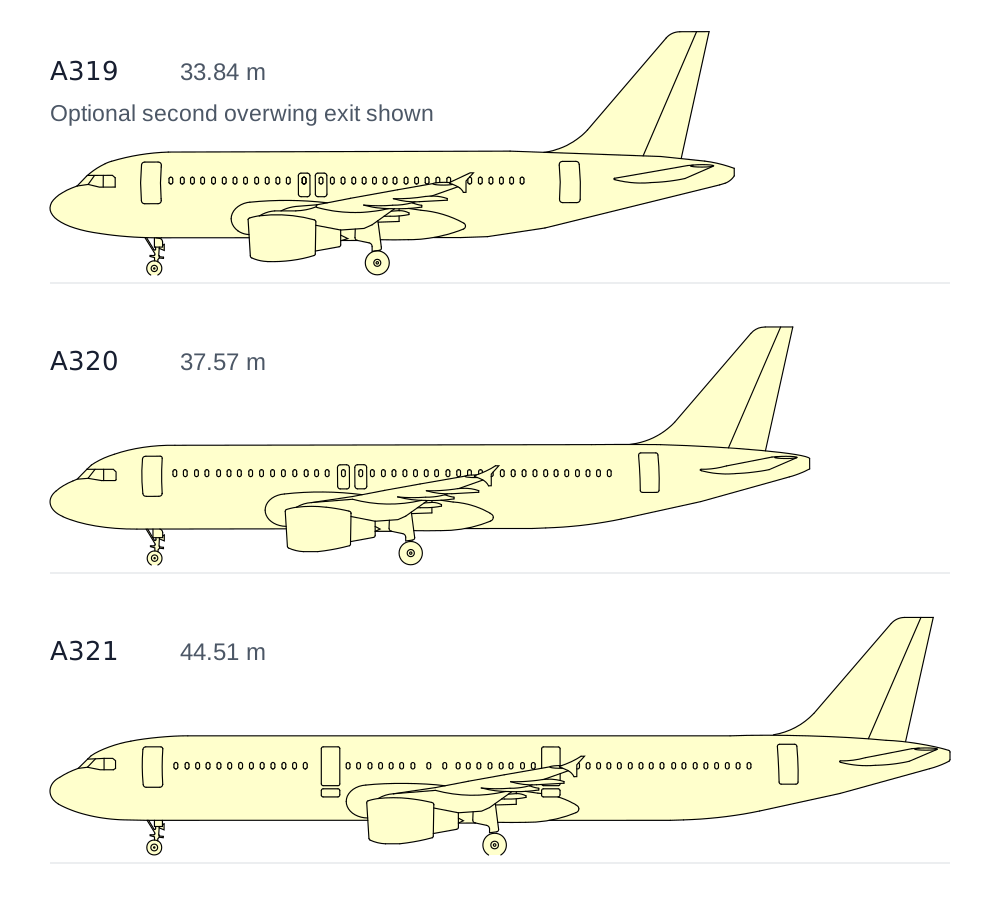
Airbus ceo side profiles at one length scale: A319 33.84 m, A320 37.57 m, A321 44.51 m. Original manufacturer contours. The A319 source shows the optional second overwing exit. [15, PDF p. 42] [16, PDF p. 44] [17, PDF p. 67]