ILS: IDENTIFICATION, CAPTURE AND MISSED-APPROACH SETUP
Confirm the intended ILS installation, frequency, identifier and course against the runway and current chart. Establish the cleared altitude and suitable intercept geometry. The raw localizer and glideslope information must agree with the approach you intend the aircraft to capture. [13, PDF pp. 159-162] [53, PDF pp. 2-4]
When cleared for the ILS and using the briefed coupled method, arm APPR at the appropriate stage. Monitor LOC and G/S through arming and capture on the FMA while crosschecking raw deviations and actual response. A localizer-only clearance calls for the appropriate LOC selection; it does not establish authority to follow the glideslope. [53, PDF p. 5] [13, PDF p. 160]
Intercept the glideslope from below using suitable cleared geometry. Once vertical capture is established, set the missed-approach altitude at the stage required by the normal procedure. Continue comparing route, clearance, modes and raw indications as the approach develops. [53, PDF p. 5]
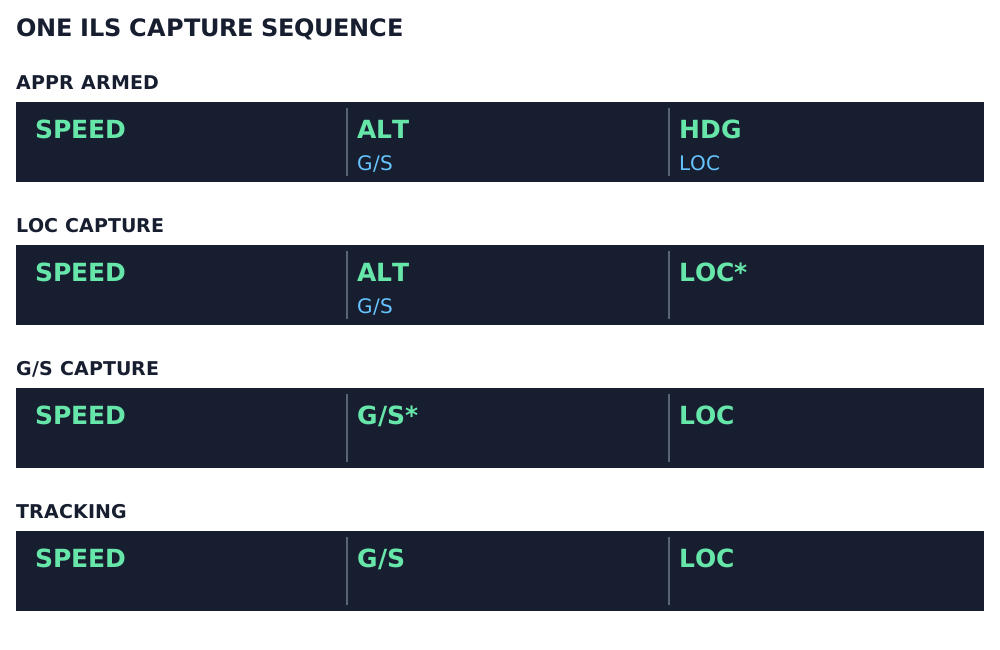
Illustrated ILS sequence, first three FMA columns only. Green: active; blue: armed. LOC* and G/S* are capture modes. Aircraft capability and AP/FD/A/THR-status columns are omitted. [13, PDF pp. 159–160]
IN PRACTICE: Capture the Heathrow ILS and confirm each handover
Before you begin: The selected runway/ILS and chart agree. The aircraft is approaching the localizer at the cleared altitude in a configuration and speed suited to interception.
1. Identify the aid you intend to use
Action. Compare the ILS frequency, identifier and course with the selected approach and chart. Press LS on the relevant EFIS controls and inspect the PFD ILS scales and identifier.
Check. The raw localizer/glideslope information is visible and refers to the intended installation. [13, PDF pp. 159-162] [26, PDF p. 474]
2. Prepare a sensible intercept
Action. Use the cleared route or vector to approach the localizer with an appropriate intercept geometry. Plan to intercept the glideslope from below on this normal exercise.
Check. The aircraft can capture the lateral course and then the vertical beam without a rushed descent from above. [13, PDF pp. 159-162] [14, PDF pp. 1091-1110]
3. Arm the clearance actually received
Action. When cleared for the ILS approach, press APPR and confirm LOC and G/S armed on the FMA. For a localizer-only clearance, use LOC. Configure the autopilot arrangement for the briefed coupled approach.
Check. The armed modes correspond to the clearance; vertical capture has not been armed merely because a localizer intercept was requested. [13, PDF p. 160]
4. Watch the localizer capture
Action. Check LOC* and then LOC, the raw deviation trend and the actual turn onto the final approach course.
Check. The aircraft has captured the intended lateral beam and is tracking the runway course. [13, PDF pp. 159-162] [14, PDF pp. 1091-1110]
5. Watch the glideslope capture
Action. Monitor G/S* and then G/S, the glideslope deviation and the actual descent. Once glideslope capture is confirmed, set the briefed missed-approach altitude on the FCU as required by the normal procedure.
Check. The vertical beam is captured, and the altitude window is prepared for a possible go-around without interrupting the established glideslope guidance. [13, PDF pp. 159-162] [14, PDF pp. 1091-1110]
6. Keep checking after capture
Action. Continue comparing raw deviations, FMA modes, speed and the outside/runway picture as visibility permits. Read the displayed approach capability against the planned minimum and autopilot arrangement.
Check. The approach remains correctly guided and suitable for the intended landing method. Capture has begun a monitoring task rather than ended it. [13, PDF pp. 159-162] [13, PDF pp. 177-183]
Complete when: The aircraft is tracking the intended ILS, with lateral and vertical capture confirmed and the missed-approach altitude prepared.