PREPARE HEATHROW BEFORE THE DESCENT WORKLOAD ARRIVES
Obtain the current destination weather and expected runway and review the arrival and approach charts together. Reconcile the enroute continuation, arrival geometry, approach and missed approach before the descent adds configuration and speed changes to the work. [60, PDF pp. 2,7-9]
Select the assigned runway and compatible arrival and approach through the destination lateral revision. For the exercise, an ILS to 27R can be prepared when clearance and simulated conditions support it. Use the current procedure identifiers and inspect legs, constraints, discontinuities and the missed approach before insertion. [26, PDF pp. 199-209]
Calculate landing performance for current mass, runway condition, weather and intended configuration. Enter the approach data and brief the actual plan: routing and intercept, intended modes, configuration and stability points, minima and missed approach. The briefing should make the coming transitions recognisable while leaving room to reassess a change. [13, PDF pp. 149-158]
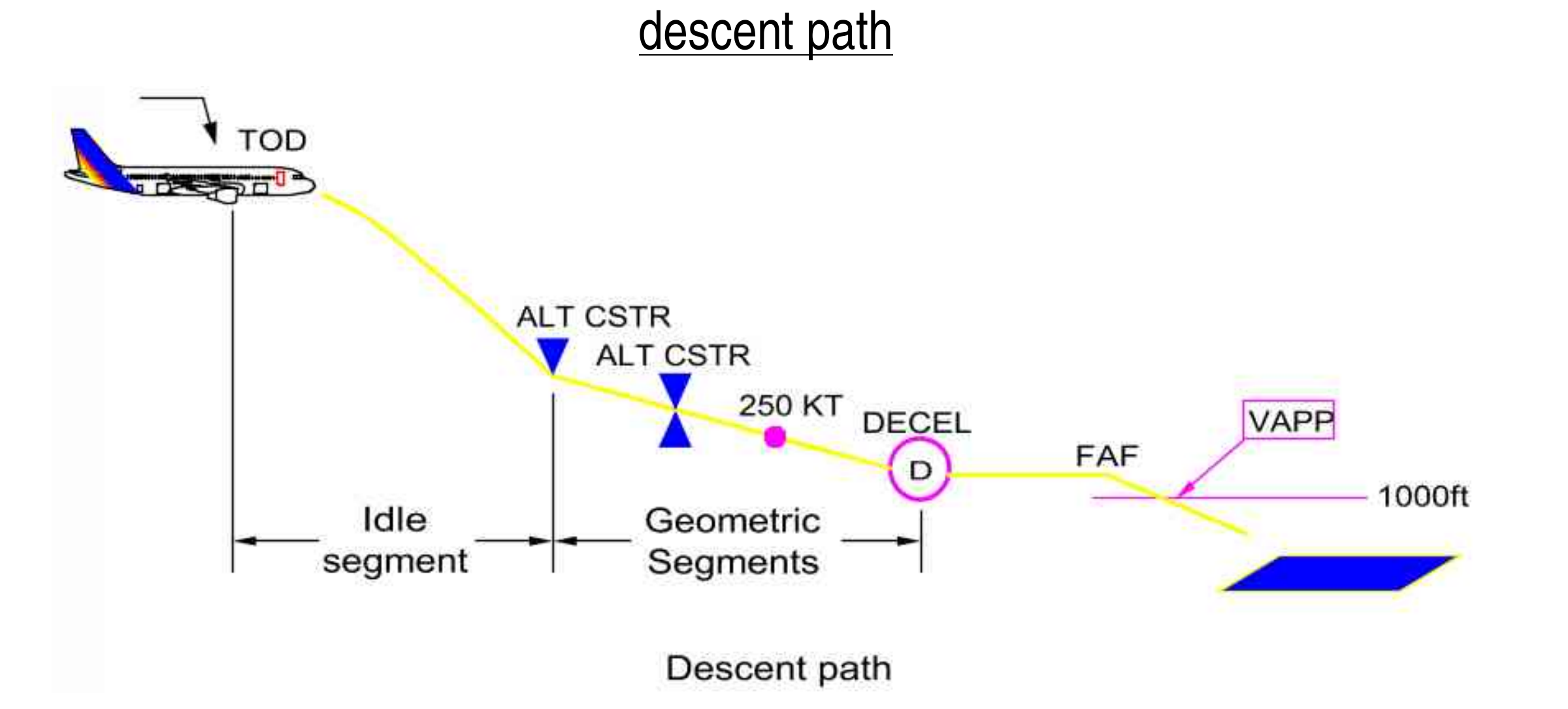
Original Airbus descent-profile construction: idle segment, constrained geometric segments, deceleration and final approach. Diagram labels are source examples. [13, PDF p. 141]
IN PRACTICE: Build the Heathrow arrival before asking for descent
Before you begin: The aircraft is in cruise or a cleared level segment. The current Heathrow runway/arrival information and charts are available.
1. Choose the actual arrival case
Action. Read the current arrival weather and expected or assigned runway. Check runway condition, wind, QNH, temperature and the approach available for that runway.
Check. The arrival is based on the actual London case, including the runway and environmental inputs needed for landing performance. [14, PDF pp. 1082-1084] [13, PDF pp. 149-158]
2. Load the arrival from the destination revision
Action. At EGLL in the flight plan, select the cleared runway, approach, STAR and transition as applicable. Inspect the temporary route before inserting it.
Check. The proposed arrival connects the cleared route to the intended approach. The aircraft has not been silently rerouted by the first plausible menu choice. [26, PDF pp. 199-209] [14, PDF pp. 1082-1084]
3. Check the legs against the chart
Action. Step through the arrival on F-PLN and PLAN display. Compare fixes, tracks, altitude/speed constraints and any discontinuity with the chart and clearance.
Check. The coded arrival is understood, including any vector or manual segment that will need a later instruction. [26, PDF pp. 199-209] [13, PDF pp. 149-158]
4. Prepare the missed approach as part of this approach
Action. Identify the missed-approach route, initial altitude and any turn or constraint. Brief how the initial climb guidance will be checked if the landing is discontinued.
Check. The alternative to landing is already a defined route and altitude, not a task to discover after selecting TOGA. [13, PDF pp. 197-200] [14, PDF pp. 1082-1084]
5. Calculate the landing case
Action. Use the current landing mass, runway/condition, wind and selected landing configuration in the landing-performance calculation. Choose the planned braking/reverse arrangement from that result and briefing.
Check. The planned stopping technique and configuration are supported by the landing-distance assessment for this flight. [14, PDF pp. 1082-1084] [13, PDF pp. 149-158]
6. Read the descent prediction with its assumptions
Action. Inspect top of descent and the upcoming constraints after the arrival, weather and speed assumptions are settled. Update the approach data, then complete the arrival briefing and Descent checklist.
Check. The computed profile has a complete arrival behind it and the descent preparation is complete before the descent request. [13, PDF pp. 141-146] [14, PDF pp. 1082-1084]
Complete when: The arrival, performance, approach data and missed-approach plan describe the same runway and current conditions.